
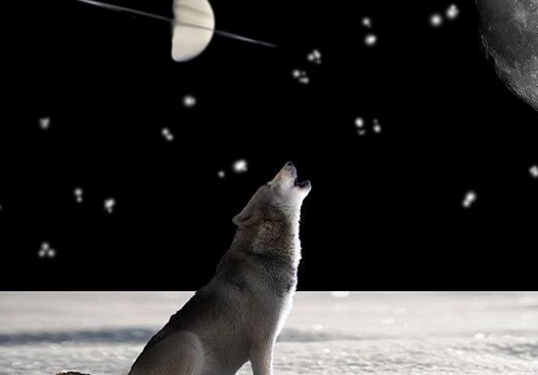
Dogs are humanity’s closest animal companions, and they are often regarded as being highly intelligent and intuitive. It is commonly believed that dogs possess human-like traits. There’s an old saying that dogs have “Eight Virtues”—loyalty, righteousness, courage, trustworthiness (diligence), wisdom (strength), diligence, kindness, beauty, and labor. When we say dogs are human-like, it means they are able to understand human commands and work in harmony with people. While many animals, such as pigs, cats, sheep, and cows, have been domesticated by humans, why is it that only dogs are considered to have human-like qualities? To understand this, we need to trace back to the wolves from which dogs evolved.
-
Dogs Evolved from Wolves
Around 40,000 years ago, with the emergence of Homo sapiens, wolves began to interact with humans. During that period, although large predatory animals like saber-toothed tigers existed, wolves were the only true competitors to humans. As social animals, wolves were formidable hunters, and humans constantly faced the threat of wolf packs. Over time, intelligent humans transformed this enemy into a friend, gradually domesticating weaker wolves into dogs for their own use. Of course, the process started when wolves began to gather around human settlements, scavenging from trash. This lifestyle was more stable than hunting, and as these wolves grew accustomed to human presence, their wariness decreased, and they gradually became more docile. Over generations, these wolves that adapted to humans passed on their submissive traits. After many generations of evolution, these companion wolves no longer needed powerful jaws or fearsome teeth, evolving into the dogs we know today.
-
The Different Purpose of Domestication Makes Dogs Unique
The domestication of dogs was a monumental achievement in human history. With the help of dogs, humans significantly enhanced their hunting skills and increased their ability to handle the threat of other wild animals. Through domestication, control, and selective breeding, many of the superior genetic traits of wolves were transferred to domestic dogs, and certain characteristics were strengthened. To this day, dogs retain many wolf-like traits: they generally have sharp vision, smell, and hearing, they fiercely defend their territories, and like wolves, they are loyal to their packs and have a clear understanding of social hierarchy. However, because the purpose of domestication differed—dogs were bred to assist humans, while cows, sheep, and pigs were primarily bred for food—the bond between humans and dogs is much deeper. Today, dogs not only keep many wolf-like traits: they still have keen senses, strong territorial instincts, and loyalty to groups, but they are also highly attuned to human communication. Dogs are used in various roles, such as shepherding, search-and-rescue, drug detection, and tracking criminals—achievements that demonstrate their close partnership with humans. Additionally, despite the vast diversity among dog breeds, they do not have reproductive isolation and can still interbreed, with more than 300–400 recognized breeds today.
-
Dogs Are Highly Intelligent Animals
Furthermore, the idea that dogs possess human-like traits is closely tied to their intelligence. Studies conducted by researchers like Brian Hare, a professor of biology and anthropology at Harvard University, have shown that dogs can understand human cues and communicate far more effectively than our close relatives, chimpanzees. Evolution has not honed dogs’ problem-solving abilities, but instead has trained them to understand humans. Dogs’ adaptability and curiosity far exceed those of many other wild animals. So, just how smart are dogs? One way to measure intelligence is by looking at the “brain-to-body ratio,” also known as the “encephalization quotient” (EQ). Humans have an EQ of around 7.5, chimpanzees 2.5, rhesus monkeys 2.1, dogs 1.2, cats 1.0, and rabbits 0.4. Clearly, dogs rank higher than cats in terms of intelligence in the animal kingdom, placing them in the upper range.
Additionally, scientists at Oxford University studied the brains of 500 mammal species that lived over the past 60 million years. They found that social animals have more developed brains compared to solitary animals. As a social species, dogs have evolved larger brains than cats, who prefer solitude, because dogs need to handle more complex social interactions. However, in recent years, dogs’ status as the most intelligent livestock has been challenged by pigs. Research by neuroscientist Lori Marino at Emory University found that pigs possess cognitive abilities on par with other highly intelligent species like dogs, chimpanzees, elephants, and dolphins. Pigs have long-term memory, excel at maze games, learn from each other, cooperate, and even display emotional traits. Despite this, the position of dogs as humans’ most loyal companions remains unchallenged.