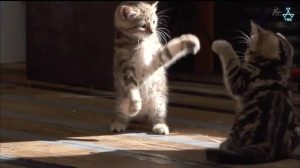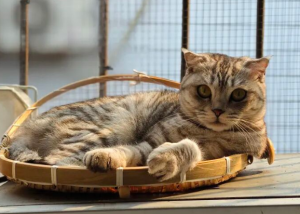

In front of a cat, all units of measurement seem insignificant. No term can truly capture the essence of this magical creature. When chasing a butterfly, it’s a cat running and jumping; when curled up and filling the entire sink, it’s a pool of cats; when sleeping inside a plastic bag and being lifted, it’s a bag of cats; when stuck in a box and unable to move, it’s a box of cats; when lying on the ground with all four legs spread out, it’s a puddle of cats… Open any video related to cats, and it’s impossible to ignore the amazed comments in the live chat: Is a cat actually a liquid? Today, let’s approach this from a scientific perspective: the reason cats break all units of measurement is that they can adapt to any container with remarkable flexibility. In short—cats, indeed, can be liquid.
-
The Liquid Cat Encyclopedia
Let’s start by revisiting some classic examples of liquid cats. After all, with all the adorable cat videos out there, we can delay the scientific theory for a bit. Let’s start with the simplest of actions. One day, a cat runs happily toward you, but then suddenly slams on the brakes just 2 centimeters from your feet, flopping onto its back with its belly up, playing dead right there on the spot. Congratulations, you’ve just witnessed a puddle of cat.Cats are the advanced version of liquid—mastering the art of “bone shrinking” to fit into all kinds of magical containers. In other words, cats are still cats, but their size and shape are as unpredictable as clay. Some cats are naive and clueless about the consequences of lying down in a pot, desperately trying to become a dish to be stirred up, oblivious to their fate. Others are so eager to be “fish” that they can’t resist flowing into a fish tank. Some cats are drawn to mysterious nooks in the house, the cool surface irresistible to them, resulting in a pool of cat in the sink. There are even cats who are so considerate of their owners that they’ll neatly pack themselves up, ready to be carried along wherever their owner goes.Cats are so smooth and soft that while humans walk downstairs, they can slide down. There’s no door gap a cat can’t squeeze through—unless, of course, its head is too big. A Japanese user tested their cat, gradually reducing the height of a door gap, and found that their chubby tabby Maru could fit through a gap as small as 8 cm, less than half the size of an adult’s palm. Watching its little feet sliding on the floor, it’s like a ball of meat turning into a pancake.
-
Science Explains: Cats Are Liquid
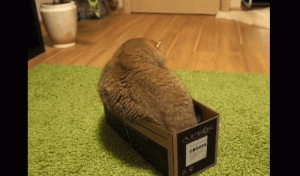
We all have a vague impression that cats have unique bones, extreme flexibility, and constantly changing shapes, which is why we jokingly say, “cats are liquid.” But even academics have joined in, and a researcher named Fading used rheology to prove that cats can indeed be considered liquid.Before we explain why cats are liquid, we first need to understand how solids and liquids are defined. A solid is a state of matter where the volume and shape are fixed. A liquid has a constant volume but can adapt to the shape of its container. In rheology, the state of a material is not fixed; it’s relative. Even a seemingly solid object, over a long enough time, may exhibit fluid-like properties. For example, mountains are considered to flow over geological time scales.In Fading’s study, the core of defining a liquid is its behavior: a material must be able to change its shape to fit a container. This adaptation requires a period of time, known as relaxation time. To illustrate: when a cat climbs into a box, it needs time to adjust its head and body to find the right position, allowing it to “melt” into the shape of the box.Whether a cat is liquid depends on how long you observe it. If you give the cat enough time to “melt,” and you witness the entire process, then it becomes liquid. In other words, when a cat is climbing into a fish tank and you watch it slowly “melt” into the tank’s shape, and once it’s fully melted, you lovingly stare at it, then, during this prolonged observation, the cat has undergone a transformation and thus becomes liquid—essentially, a tank of cat.However, if you just glance at the cat briefly, its shape will be stable and clear during your quick observation, meaning it’s a solid cat. So, it turns out that your patience with the cat determines whether it’s liquid or not. Interestingly, older cats are more likely to become liquid than hyperactive kittens. This is because older cats have a shorter relaxation time, and their laziness allows them to easily fall asleep and turn into a “puddle” of cat. Kittens, on the other hand, are often busy jumping and running around, making it harder to keep them still in a container.Another theory is that older cats may have an easier time fitting into containers because of their larger size. For example, while a kitten may have to climb all the way into a glass cup, a well-fed older cat only needs to fit in its two little paws. Fading’s research also found that cats have a shorter relaxation time when stretching vertically compared to horizontally, which might explain why even when they sleep into a puddle of cat, it often lasts a long time.Moreover, we notice that regardless of whether there’s a container, cats love chasing their tails. If we think of cats as liquid, their crazy spinning can be seen as a vortex-like swirl. But unlike water, which is passively moved by forces, cats actively spin with their own energy. Now, for those who haven’t owned a cat yet, you might start imagining: if I pour a bowl of water on a fabric, it will soak in; but if I pour a cat on my bed, will it soak in too? Unfortunately, while water will leave stains when it’s poured out, cats leave behind only pesky fur.
-
Why Cats Are So Liquid-like
Why are cats so liquid-like? It’s in their nature. First of all, cats are incredibly slick, with fur as smooth as silk. Anyone who has petted a cat can never forget the delightful sensation of their fur. In fact, many people even wonder online: Why does petting a cat feel better than petting a dog? This is because cats are refined little princesses who constantly groom themselves. Anyone who has observed a cat knows that one of their daily rituals is licking their fur repeatedly, a behavior humorously referred to as “eating their feet.”Cats have this habit because they don’t sweat to cool down. Instead, they rely on the evaporation of saliva on their fur to dissipate heat. Their rough tongues, covered with hook-like barbs, help them remove dirt and parasites, which is why you won’t feel sticky or get dirty when you pet them. This self-cleaning process also stimulates the production of sebaceous glands, making their fur smooth and shiny—just the right texture for an irresistibly soft petting experience.Additionally, cats can quickly become a puddle of cat, a cup of cat, filling every corner of any container because they have enough meat on their bones. A new study from the University of Guelph has found that the average weight of North American domestic cats has increased by 1 pound in the past 25 years, which accounts for 20% of their body weight. Most cats are overweight, and this makes them especially soft. When you pet them, you’re just feeling a handful of fat—how could they not be soft?Furthermore, a cat’s bones allow it to perform all sorts of high-level movements. People often forget that despite their cuteness, cats, like all felines, still possess the instincts of hunters and predators. Their evolution has naturally led them to be more flexible and agile.
Humans have long collarbones that connect the sternum and shoulder blades. But a cat’s shoulder blades are connected to the rest of its body by muscles rather than bones. While cats do have collarbones, they are much smaller and more delicate, which means they can squeeze through tiny gaps. Whether these traits are the reason cats are so liquid-like is still uncertain, but one thing’s for sure—these cats are incredibly easy to pet.