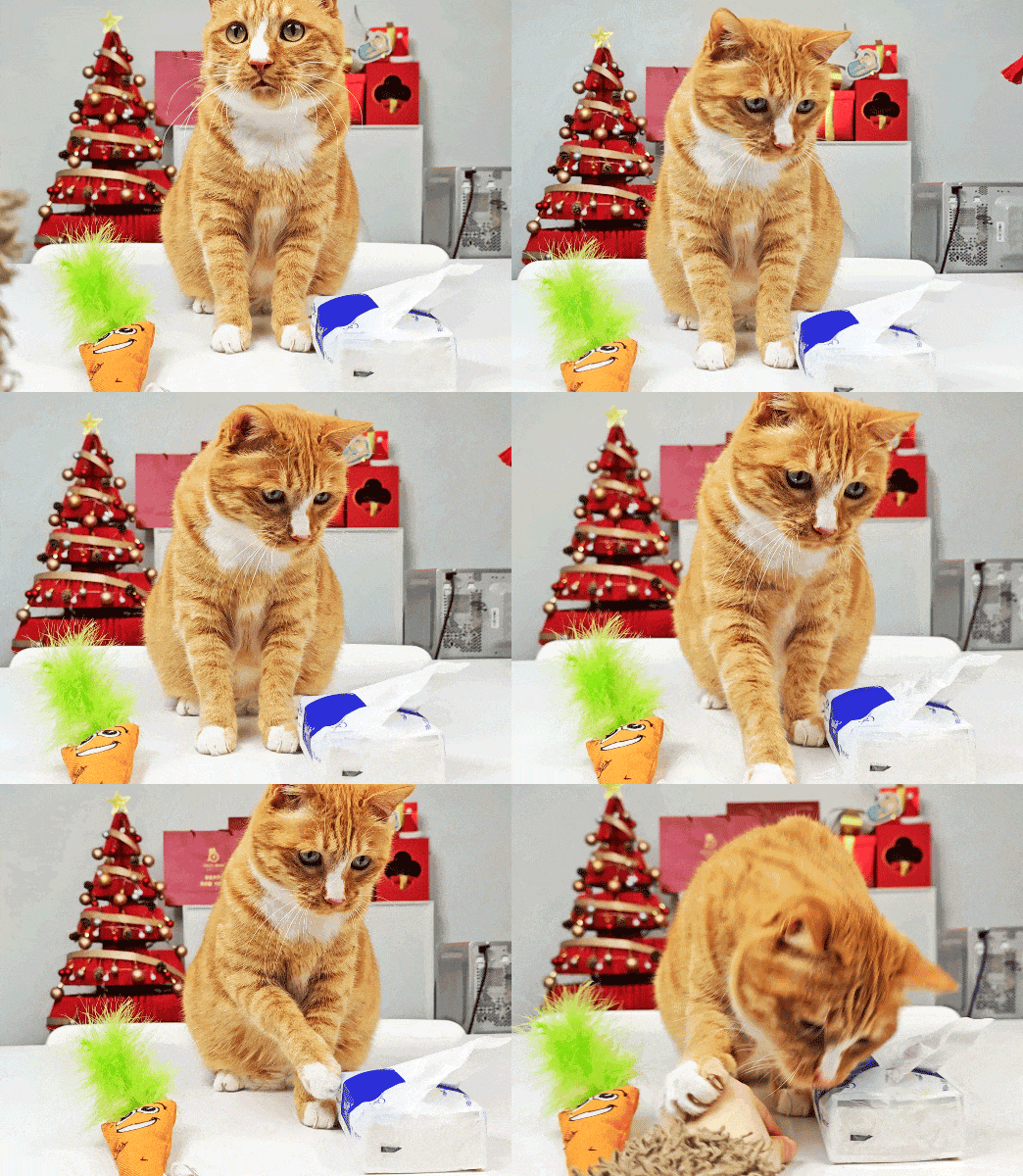
As high-intensity internet surfers and cat owners who still find themselves indulging in “cloud cat petting” every day, you’ve probably come across the viral video “Carrots, Tissues, So Awesome!” lately. However, while everyone on the internet is having fun with memes and remixing the content, it has also sparked some scientific curiosity among cat owners: With a cat’s level of intelligence, can they really tell the difference between “carrots” and “tissues”? Is it just a lucky guess when they get it right? Let’s dive into the details and explore this question!
-
Can Cats Accurately Identify “Carrots” and “Tissues”?
The obvious answer is: No! While a 2005 study showed that cats have strong visual recognition abilities and can use visual input and memory to distinguish between familiar and unfamiliar objects, this only means that cats can remember and differentiate between items with distinct appearances, like “carrots” and “tissues” (note the emphasis here). However, to accurately identify an object through a verbal cue (such as hearing the word “carrot” and identifying it), a cat would need to understand the language instruction and connect the spoken word (a sound symbol) with the actual object (a sensory entity). This is a much more advanced task… It may be easy for us humans, but in reality, initiating this process requires strong cognitive abilities and the coordination of multiple brain regions. We can think of this process simply as follows: Cats, however, have small brains, smooth cortical folds, shallow sulci, a small frontal lobe, and lack specialized language centers (such as Broca’s and Wernicke’s areas), with fewer neurons overall. This means that cats simply don’t have the brain capacity to process such complex neural activities. Therefore, getting cats to form symbolic associations with objects through language (for instance, associating the word “carrot” with the visual image of a carrot) is incredibly difficult.
-
Cats Identify Objects Through Classical Conditioning
The connections cats form are more akin to a “signal-result” classical conditioning model. After repeated training, cats learn: hearing a specific sound—touching a specific object with their paw—results in receiving a treat. This is a simpler, direct-trigger behavior. However, if you change the environment, the sound, or swap the carrot for a pepper with a similar shape and color, the association may fail… Because cats don’t understand the abstract concept of “carrot,” but rather rely on a whole set of environmental cues and actions. So, if you want to train your cat to play this kind of game, don’t make the commands too complicated. It’s best to stick with one word or a consistent sound like a bell or clicker, and try not to change the target object too often. After all, cats’ little brains aren’t the best at processing all these changes… But no need to feel sorry for them—although their brains may not be sharp on this, they have other tricks up their paws.

-
Cats Are Experts at “Reading the Room”
While cats may not be great at solving problems with their brains, they are quite skilled at “cheating” by reading the environment and cues around them!
-
Cats Can “Read the Room” Through Eye Contact
In 2018, a team from the Department of Animal Science at Eötvös Loránd University in Hungary conducted a study to examine whether cats could track human gaze and interpret eye cues. The researchers prepared two identical bowls (2 to 2.5 meters from the cat), one of which contained a small piece of food (both bowls were lightly coated with food to eliminate scent interference), and mixed up the bowls’ positions multiple times. During the experiment, the researchers guided the cats to the correct bowl containing the food using various “eye cues.” The results showed that all 41 cats in the study were able to catch the eye cues, with a 70.42% success rate in finding the hidden food, significantly higher than random chance. This suggests that cats can indeed understand and follow our gaze for helpful information.
-
Not Just Eye Contact—They Also Read Facial Expressions
In 2015, researchers at the University of Auckland in the U.S. conducted an experiment to investigate whether cats could distinguish human emotional signals. The researchers placed 12 cats in individual cages and had either the researcher or the owner sit in a designated spot, displaying pre-designed positive and negative facial expressions (silent) to observe the cats’ reactions. The experiment revealed that cats were quick to notice changes in human facial expressions and emotions, adjusting their behavior accordingly (approaching those showing positive emotions). In 2020, Italian researchers extended this study by adding sound. They showed 10 cats, aged 2-10, images and sounds of their owners and other cats expressing happiness and anger, then observed the cats’ responses. The results showed that cats could distinguish between the different emotional expressions of other cats and their owners, associating these emotions with sounds like laughter or angry voices. In other words, while cats may not understand our language, clever cats can interpret our gaze, facial expressions, and other signals (like whether we’re smiling or preparing food) to adjust their behavior.
Although kittens may not understand the meaning of the word “carrot,” those that can obediently sit and respond to commands, complete conditioned reflex tasks, or even “cheat” by reading the room to get the right answer, are already standouts in the cat world. They definitely deserve a big “Good Job~!!!”