
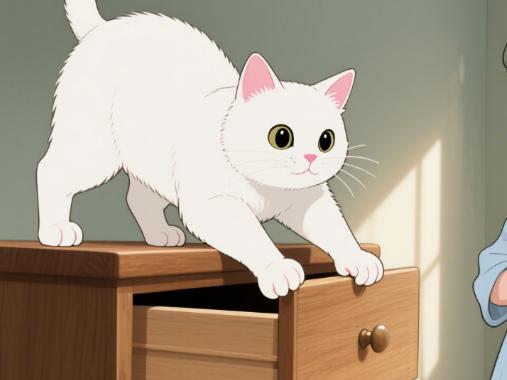
It’s often said that cats are aloof, independent, and live in their own world. However, anyone who has ever had a cat knows just how intuitive they can be. After living with cats for a while, you’ll notice that they can do things that humans do, and sometimes even better. Below are some “human-like” behaviors in cats—check how many of these your cat displays.
-
Mimicking and Learning
Does your cat open doors, drawers, sit and watch TV, or even scroll through your phone? This isn’t because cats are unusually smart—it’s because you, as the owner, taught them well. Cats have strong observational and mimicking abilities. They quietly observe their owners’ behaviors in daily life and try to imitate them. Studies show that a cat’s mimicking behavior is a way for them to learn and adapt to the human environment. When they mimic their owner’s actions, they receive attention and interaction, which makes them feel closer to their humans. Cats truly go to great lengths to integrate into their owner’s life. With such human-like qualities, it’s no wonder you can’t help but smile.
-
Synchronizing Their Schedule
Ever noticed how your cat’s biological clock seems to be perfectly in sync with yours? After adopting a cat, I realized that our daily rhythms align remarkably well. Every morning, before I’m fully awake, I feel a little fluffy head nudge my face, meowing to wake me up. Then at night, as I finish my bedtime routine and get ready for bed, my cat stops playing and obediently jumps on the bed to curl up in a cozy spot. This near-perfect synchronization isn’t just a coincidence—it’s the result of the cat’s efforts to adapt to the household. Studies have shown that after joining a new home, cats memorize specific sounds associated with their owner’s activities, such as alarm clocks, cooking, and door opening. When these sounds occur regularly, cats form conditioned responses, gradually adjusting their behavior. Furthermore, cats release oxytocin—”the love hormone”—when interacting with their owners. This not only strengthens the emotional bond between them but also influences their activity rhythm, making them more likely to engage when their owners are active and remain quietly present during rest. Cats really do live like they’re part of the family.
-
Quietly Providing Comfort
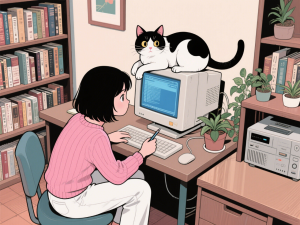
When you’re working late at night, your cat might hop onto your desk, curl up into a ball, and rest its warm body against your arm. They usually don’t make a sound, just quietly keeping you company, as if to say, “Don’t worry, I’m here with you. You’ve got this.” Who wouldn’t be touched by such thoughtful companionship? Many humans can’t provide this kind of gentle support. Cats are also keenly aware of your emotional state. When you’re feeling down, they’ll notice and gently approach, rubbing against your arm or sitting on your lap, comforting you in their own way. Studies have found that cats can detect human emotions through body language and changes in scent. When humans are feeling low, hormonal changes alter the scent of sweat and breath, and cats can recognize these signals. They often respond by offering quiet companionship, showing their deep empathy. Cats are truly some of the most gentle beings on the planet, appearing just when you need them the most.
-
Caring When You’re Sick
Anyone who’s owned a cat knows that when your cat isn’t feeling well, you’re filled with anxiety, wishing you could take their pain away. But did you know that when you’re sick, your cat also gets worried? Research has shown that cats are highly sensitive to temperature changes and can detect abnormal body temperatures. When their owner is unwell, they change from their usual playful selves to being unusually quiet and gentle. They might curl up by your pillow, gently nudge your forehead with their furry head, almost as if checking your temperature. Sometimes, they’ll lick your fingers, as if trying to comfort you like a mother soothing a sick child. In their own way, cats guard and protect their owners until they’re better—truly the most caring companions.
-
Protecting Their Owner
Don’t let their cute and cuddly appearance fool you—cats can be fierce protectors when the time comes. For instance, if you and a friend are playfully “roughhousing,” your cat might think you’re in danger. They’ll stand on alert, with their ears up, back arched, and a low growl, sometimes even charging to your defense. Research suggests that cats’ protective behaviors stem from their territorial instincts and emotional attachment to their owners. When their owner is threatened, cats perceive the danger as an invasion of their territory or social group, triggering their fight instincts. Cats that receive lots of love and attention from their owners are more likely to exhibit these protective behaviors. Despite their small size, cats show immense courage in guarding those they love. This protective instinct is just another way cats show their “human-like” qualities—they see their owner as the most important person and will do anything to protect them.
How many of these behaviors does your cat display? Feel free to share your thoughts, pictures, and cat parenting tips in the comments below!