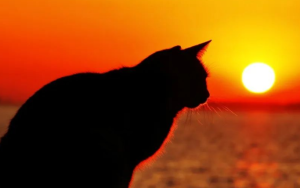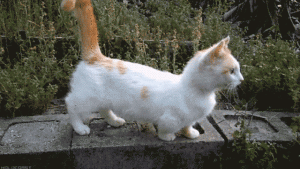
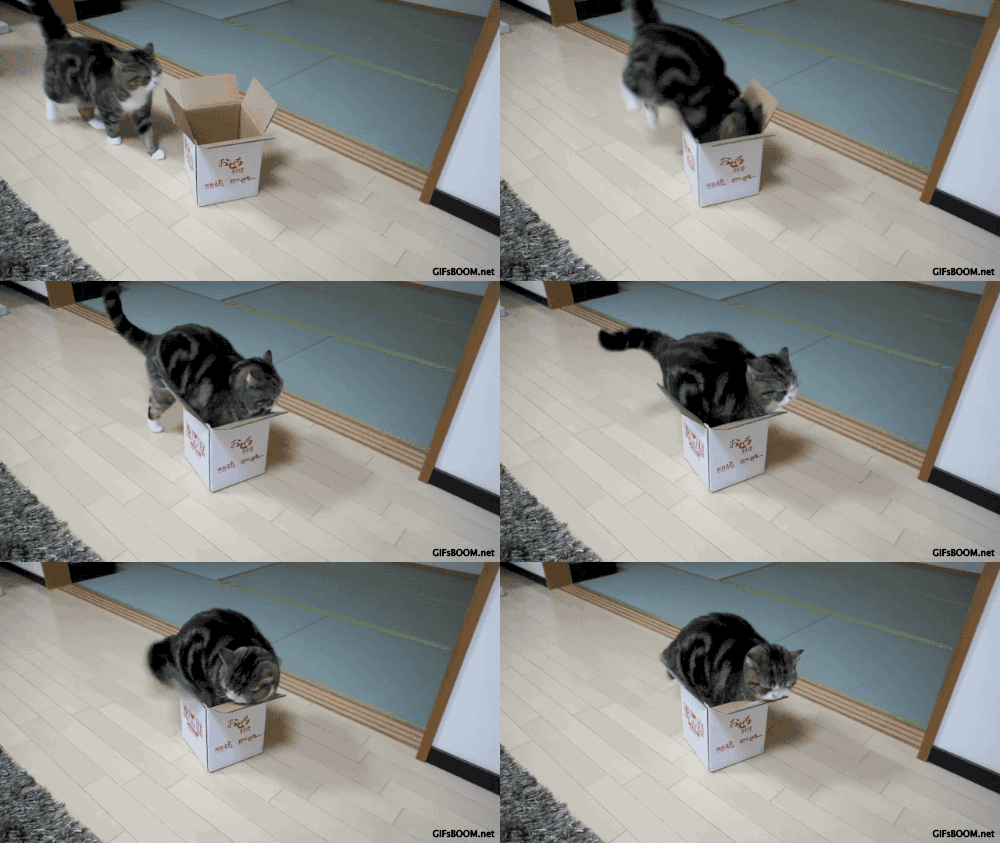
“Have you ever noticed that your cat seems a bit strange? Despite being a little chubby, it somehow manages to squeeze itself into all kinds of containers, effortlessly changing its body shape. Sometimes it looks like a square; other times, it’s round. And occasionally, it can even squeeze through the tiniest of gaps… Could this cat be made of water? Why is your cat’s body so flexible? According to scientists, they are actually ‘liquid’!”
-
Fluffy Fur and Unique Skeletons
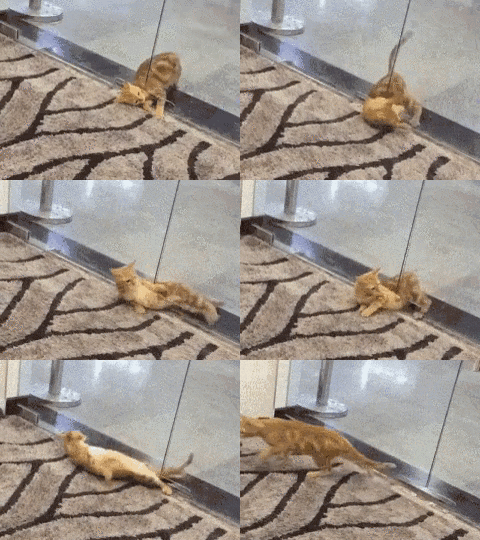
Let’s start with your cat’s fur. Whether it’s a common domestic cat or a purebred, most cats have fluffy, smooth fur that makes them look like little balls of fluff. But that’s all just an illusion. Once they take a bath, their whole demeanor changes. These cats may seem “chubby,” but in reality, they’re just full of fluff! While they may look a bit fat, they certainly don’t get stuck in small spaces easily. In the cartoon Tom and Jerry, Tom the cat gets stuck in a pipe—well, believe it or not, real-life cats sometimes get stuck in tight spots too. The secret behind their seemingly impossible flexibility lies in their special skeletal structure. Including the tail, cats have up to 53 vertebrae, while humans only have 33. To break it down, cats have 7 cervical vertebrae (just like humans), 13 thoracic vertebrae (humans have 12), 7 lumbar vertebrae (humans have 5), and 3 sacral vertebrae (humans have 5). Most cats also have 22-23 caudal vertebrae (humans have just 3-5). Furthermore, their vertebrae are connected by highly flexible intervertebral discs. With the extra thoracic and lumbar vertebrae, this setup allows cats incredible flexibility, enabling them to rotate their bodies 180 degrees, while humans can only manage 90 degrees. Additionally, a cat’s spine is controlled by muscles, unlike humans, whose spines are controlled by ligaments. This gives cats the ability to bend upwards or move their bodies along the spine, compressing and stretching their backs like a spring. Unlike humans and dogs, cats’ scapulae are connected to their bodies through muscles, not a clavicle. This allows them to stretch their bodies even more and take larger strides. Furthermore, cats have small, loosely attached collarbones and long, slender ribcages shaped like arcs, which allow them to flatten their bodies and squeeze through incredibly narrow spaces. Put simply, if their head fits, and they’re not too chubby, the rest is easy!
-
Don’t Ask, It’s Survival Instinct
The flexibility and agility of cats are also deeply connected to their lifestyle. Unlike dogs, which were domesticated from wolves and are naturally pack animals, cats evolved from African wildcats and are solitary hunters. To survive, they need to be faster and more agile, constantly adapting to catch prey and avoid predators. This is why, over millions of years, cats have evolved such a flexible skeleton. So, the next time you see your cat performing a difficult feat, don’t be surprised—it’s the result of generations of practice and evolution.
-
Liquid or Solid? You Decide
The way cats behave has even caught the attention of scientists. In fact, there’s been a study titled “Is a Cat Liquid or Solid?” that even won the “Ig Nobel Prize” for humor. The article humorously explored the nature of cats from a fluid dynamics perspective. It explains that a material is considered a liquid if it can change shape and adapt to its container. This change requires time, and we classify something as solid or liquid based on how long we observe it. Even a glacier, which seems unbreakable, could eventually melt into water over geological time, making it a liquid. So, whether your cat is liquid or solid depends on you. If you sit and watch in amusement as your cat slowly molds itself into a fish tank, it’s a liquid. But if you only glance briefly at the process, it might just appear solid!
So, if you don’t have a cat yet, here’s a little tip: Just get a cardboard box, and you’ll have a cat in no time.