Have you ever noticed how diverse the eye colors of domestic cats are? They can practically form a rainbow! From blue to yellow, green to orange, and orange to brown, the color spectrum in a cat’s eyes is vast, with each shade varying in hue and brightness. You might be wondering, “How many colors are we talking about here?” Well, let me tell you—it’s even more than you think! The color variations are continuous, and there are cases of cats having different-colored eyes or even multiple colors in one eye. Has anyone ever taken the time to count just how many eye colors cats really have?Some eye colors are linked to coat colors, but that’s not the focus of this article. In most cat breeds, multiple eye colors can occur, and breeders often select eye colors that complement the coat color when establishing breed standards. For example, breeders tend to prefer purebred black cats to have bright, vivid orange-yellow eyes. However, it’s also common for black cats to have green or yellow eyes.
-
Where do the eye colors come from?
The color of a cat’s eyes is influenced mainly by two factors: iris pigmentation and blue light refraction. The iris consists of two layers: the stroma and the epithelial layer. Both produce pigment, with the difference being in the amount. Iris pigmentation comes from melanin, and the color range varies from lemon yellow → light greenish-brown → deep orange-yellow or brown. Now, let’s talk about the “transparent” structure in front of the cat’s eye. This structure, which resembles glass, absorbs and refracts light. From the front, it appears transparent, but when viewed from the side, it can appear greenish or blueish. The stroma layer determines how light is reflected and refracted, affecting the blue hues from colorless to deep blue or violet. In this way, the combined effect of iris pigmentation and blue light refraction determines the overall color of a cat’s eyes. Imagine looking into a cat’s eyes as if you were peering through a light blue glass window—this will naturally influence the iris color you see. So, who determines the pigmentation and the transparency of this structure? The answer is: genetics! The interaction of multiple genes creates the wide variety of eye colors in cats. More specifically, the types and brightness of a cat’s eye color are determined by the number and activity level of melanocytes in the eyes.First, in terms of quantity, if there are no melanocytes, the eyes will be blue (in rare cases, pink eyes can occur, which is the color of the blood vessels). A small number of melanocytes results in green eyes, while a large number leads to orange eyes. Second, the activity level of these melanocytes—how much pigment they produce—determines the shade. Less pigment results in lighter tones, while more active cells produce deeper, richer tones. The shades range continuously from light to dark. For example, a small number of melanocytes, depending on their activity, can result in eye colors ranging from light green to dark green. Similarly, yellow can range from light amber to deep copper. Finally, light passing through the “light blue structure” influences the final eye color we see.Kittens are born with blue eyes, and by 6 to 7 weeks of age, their eye color begins to change, but it takes 3 to 4 months before their eyes reach their adult color. Throughout a cat’s life, disease or injury may change the color of their eyes, but I must clarify that the rumor about feeding cats fish to change their eye color is false! Also, the eye reflection seen in photos is caused by another structure called the “tapetum lucidum,” which humans and other primates do not have. This structure helps cats improve their vision in low light. However, most blue-eyed white cats do not have a tapetum lucidum, so in photographs, their eyes typically reflect red (the color of the blood vessels).
-
Blue Eyes
Just because a kitten is born with blue eyes doesn’t mean its eyes will stay blue as it grows up! Only a few breeds have permanently blue eyes. Blue-eyed white cats are not necessarily deaf. Let me throw in an example from the dog world—the Husky. Huskies also have blue eyes at birth, but by 7 to 8 weeks, their eyes may begin to change. They might stay blue, turn brown, or even have heterochromia (two different-colored eyes). This is not related to whether the dog is purebred or not—Huskies with blue eyes are not the only purebred ones! White cats can have one blue eye or both eyes blue, for example, white Persian cats.

-
Green and Sea Green
Color range: from yellow-green → gooseberry green → deep green or blue-green. Chinchilla Persians and their short-haired relatives are known for their dark-edged sea-green eyes. The Turkish Van breed has eyes in a beautiful sea green.
-
Yellow, Orange/Amber, and Brown
There is overlap between yellow, brown, and yellow-green. Among these, orange-yellow eyes, often referred to as copper-orange, are the most typical.
-
Heterochromia (Two Different Colored Eyes)
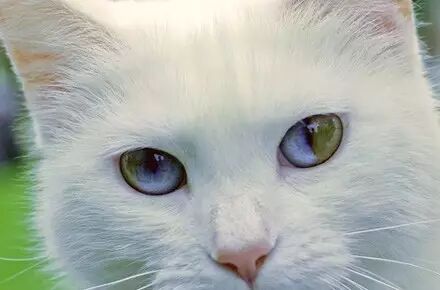
Heterochromia typically manifests as one blue eye and one orange, yellow, brown, or green eye. Purebred white cats with heterochromia usually have one blue eye and one orange or amber-colored eye, but in randomly bred cats, non-blue eyes can be yellow, green, or brown. Some white cats may even have both blue eyes, but due to different eye structures, one side may reflect green and the other side may reflect red in photos. Additionally, some bicolor cats with predominantly white fur may also have heterochromia. There are also rare cases where tortoiseshell cats have one blue eye and one yellow eye. And of course, cats that suffer from injury or disease may develop heterochromia, but we won’t go into that here.
-
Bicolor Eyes (Same Eye, Two Colors)
Bicolor eyes refer to having two distinct colors in the same iris. For example, a green iris might have a yellow ring around it. While this might be considered a flaw in competitive cat shows, it’s also quite captivating. Even rarer is the presence of completely different color blocks within the same iris, such as a brown area in a blue or green eye. This could be caused by the white gene affecting only part of the iris.
-
Albino/Pinkish/Blue-eyed Albino Disease
Albinism exists in Siamese cats, usually due to inbreeding. Pink eyes are not a normal eye color for cats. This is due to a complete lack of pigment and very little blue light refraction. True albinism is characterized by a complete lack of melanin, which results in a pale pinkish-white iris. With blue light refraction, these eyes often appear bluish, but it should be noted that they are distinct from the blue eyes mentioned earlier. In rare cases, the refractive structure may be completely colorless.
You thought figuring out a cat’s eye color was a simple task? Getting lost in this colorful “world of cat eyes,” right? Well, it’s definitely more complicated than it seems—and way more beautiful than the eye color of any two-legged creature!