-
Ancient Egypt — The Worship of Cat Gods
Bastet was a goddess with the head of a cat and the body of a woman in ancient Egyptian mythology. She began to be worshiped as early as Egypt’s Second Dynasty (2890–2686 BCE). Before the unification of Upper and Lower Egypt, Bastet was the goddess of war and a protector of Lower Egypt, but gradually transformed from a war goddess into a guardian of the home, symbolizing family happiness, and became highly favored by the people of Egypt. The worship of Bastet was also prevalent among the elite. By the 10th century BCE, Egyptian pharaohs began to revere Bastet. Pharaoh Osorkon II (reigned 872–837 BCE) even claimed to be “the son of Bastet” and emblazoned her image on royal insignia. Many temples dedicated to her were built across Egypt, including in cities such as Memphis, but the most famous was the Temple of Bastet in the city of Bubastis. The ancient Greek historian Herodotus commented, “There are temples that are larger and more expensive, but none more pleasing to the eye than this one.”
-
The Middle Ages — The Black Cat Taboo
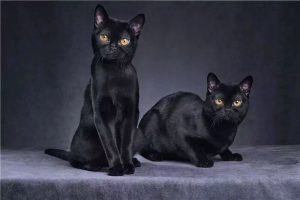
From the ancient Mediterranean civilizations to medieval Europe, the image of the cat underwent a dramatic shift in the Western world. Beginning in the 12th century, Europeans began associating black cats with devils and pagans. In the 13th century, Pope Gregory IX issued a decree officially declaring black cats as guardians of pagans, eventually leading to widespread cruelty toward cats across Europe. In the 15th century, the British merchant William Caxton even compared “devils and sinners” to “cats and mice,” further tarnishing the reputation of cats. Ironically, at that time, people also associated cats with the Black Death; it wasn’t until the 19th century that scientists determined the Black Death was caused by the plague, and the mass killing of cats may have worsened the epidemic. Swansea University scholar Ilina Metzler believes, “The independent nature of cats became a source of anxiety for medieval humans.” However, not everyone hated cats at the time. Records show that many European nuns kept cats. In regions of Russia that were not under the control of the Catholic Church, cats had a dual nature, sometimes representing good fortune, sometimes playing tricks. Medieval Muslims were also fascinated by cats, with a famous story about Prophet Muhammad, who reportedly preferred cutting off his sleeve rather than disturbing a cat sleeping on it.
-
Japan — The Phantom Cat Yokai
According to the Encyclopedia of Japanese Legends published by Kadokawa Shoten, “Due to their eyes and behaviors, cats have long been considered to possess magical powers in Japan.” This gave rise to images like the “Bakeneko” (ghost cat) and the “Nekomata” (two-tailed cat). The earliest mention of the Nekomata can be found in Japanese texts from the Kamakura period. The famous poet Yoshida Kenkō wrote in Tsurezuregusa (The Essays in Idleness): “In the deep mountains, there is a creature called ‘Nekomata,’ which is feared and may even eat people.” By contrast, the image of the “Bakeneko” was more anthropomorphized. The Encyclopedia also recorded stories of house cats in places like Saga, Japan, transforming into humans to take revenge on their owners. Compared to Egypt, cats were a foreign import in Japan. Literary critic Hirotomi Kitajima mentioned in The Mysterious History of Cats in Japan that cats were brought to Japan by the envoys sent to China during the Tang Dynasty, and house cats were originally only found in the Japanese imperial court. Perhaps it was this air of aristocratic mystery that made cats in Japanese folklore so mystical.
-
The Classic of Mountains and Seas — Rare and Exotic Beasts
Ancient Chinese myths surrounding cats are similar to those in Japan and even served as the source of many of the strange cat tales in Japanese folklore. In contrast, in the ancient Classic of Mountains and Seas, the exotic beasts based on felines were depicted in more fantastical ways. The Western Mountains Classic records a beast called “Huan,” which “resembles a civet, with one eye and three tails,” and whose call sounds like a hundred voices. The text also notes that the “Huan” can ward off evil and cure damp heat. The Inner Classic of the Sea describes a creature known as “Kai Ming” living in the southern depths of Kunlun. This creature had the body of a tiger but nine heads, each with a human face. The “Kai Ming” beast, with its tiger body and human faces, bears a striking resemblance to the Egyptian sphinx. Another creature, “Zou Yu,” described in the Northern Sea Classic, was said to be “as large as a tiger, with all the colors of the rainbow, and its tail was longer than its body.” It was also said to travel a thousand miles in a single day. Later generations passed down stories about the “Zou Yu,” which was believed to be a kind-hearted creature that never ate living beings. Ancient people always viewed nature with a mix of reverence and awe.
-
Aztec Civilization — The Totem of War
Expanding our view to all big cats, we find that human reverence for “large cats” has never stopped. Before the Age of Discovery, the jaguar had long been a symbol of power and strength in Central and South America. The Aztec Empire in Mesoamerica considered the jaguar to be the totem animal of the powerful god Tezcatlipoca. The jaguar also appeared as a ruler and warrior in murals in the capital city of Tenochtitlan. The elite soldiers of the Aztec empire were known as “Jaguar Warriors,” and they fought across the empire. However, with the arrival of the Spanish colonialists during the Age of Discovery, the Aztecs were unable to resist the invasion.