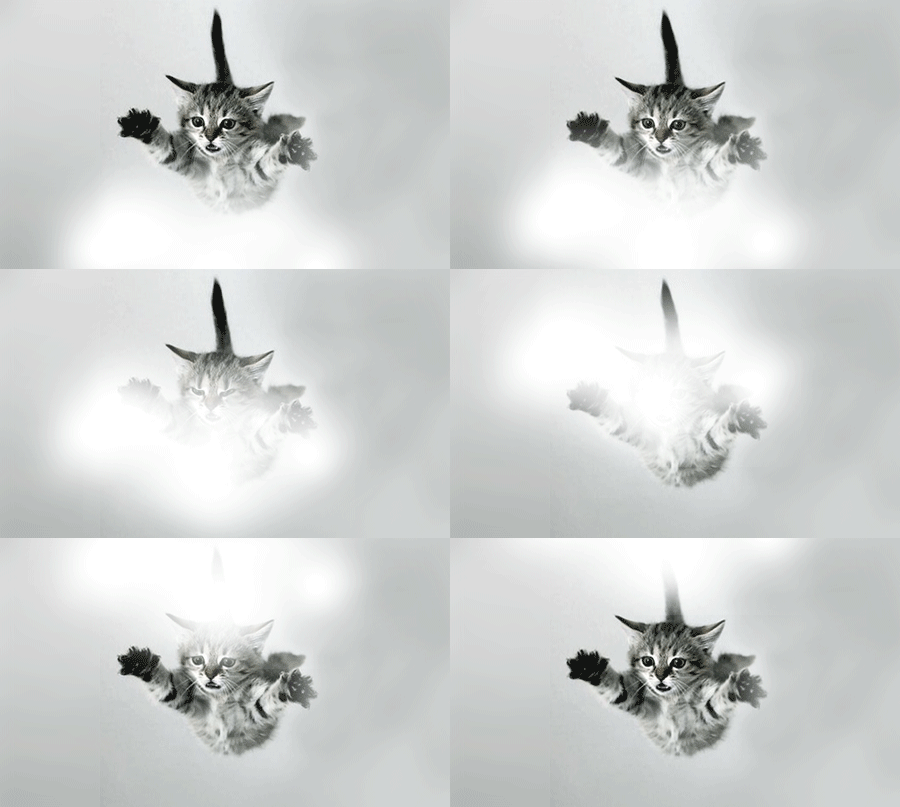
In October 1894, at a meeting of the French Academy of Sciences, the renowned physiologist Étienne-Jules Marey presented a series of photographs that left his colleagues stunned. In subsequent reports, one of the attendees claimed that Marey had merely introduced a scientific paradox that violated the fundamental laws of motion. The controversy was sparked by a cat. More specifically, it was about a cat falling from the air, twisting mid-air, and eventually landing safely. While the fall and landing themselves were not the issue, the peculiar part was the cat’s twisting motion during the fall. For years, scientists had believed that for a cat to land safely, it needed to jump from a fixed surface. This idea was rooted in the concept of angular momentum conservation, which states that an object will not move unless acted upon by an external force. Without thrust, a cat would not have a lever to rotate itself.However, Marey’s series of photographs showed something entirely different: a cat twisting mid-air after starting its descent, yet there was nothing around it. In the decades that followed, scientists offered many explanations, though most were vague. “Even today, you’ll find people still debating the mechanics of how cats land,” says Gerber, author of The Falling Felidae and Basic Physics. What experts generally agree on is that this behavior of cats likely doesn’t violate the laws of physics; rather, cats may have evolved to exploit the most subtle of physical differences, even in environments where survival seems impossible.Gerber told me that physicists at the French Academy of Sciences, confused by this phenomenon, had oversimplified the cat’s angular momentum. Angular momentum can still be conserved in a rotating object (like a cat) as long as one half of its body rotates in one direction, while the other half rotates in the opposite direction. It almost sounds like a pepper grinder at work. Then, each side of the body acts as a pivot point, applying equal and opposite forces to one another—this is the concept of rotational force. This phenomenon is exactly what occurs with cats.
-
Cats Have Extremely Flexible Skeletons
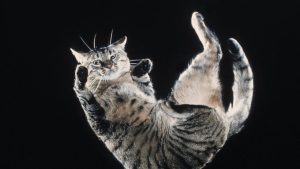
A cat’s spine is incredibly flexible, allowing it to bend its body almost as if splitting it in two. This is comparable to saying, “Your back can move the same way your knee does.” When a cat is suspended in mid-air, the half of its body closest to its head typically rotates first. To achieve this, this part of the body must rotate faster than the rest—sometimes, the cat tucks its front paws toward its belly while keeping its back paws extended. Then, the cat relaxes its front legs and tucks its back legs into its belly. This time, the rear half of the body rotates faster, shifting the rest of its body into an upward position. Meanwhile, the tail may act as a propeller, helping to accelerate the body’s rotation. Interestingly, this isn’t always necessary, according to Gerber: even the Manx cat can land safely.
-
Cats Twist Their Bodies at Astonishing Speeds
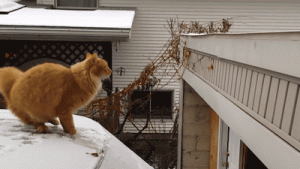
Cats can reposition themselves in just a few feet, a process that only takes a fraction of a second. It is thanks to this ability that Eisen’s mischievous kitten, Mush, was able to survive a fall from a window about 40 to 50 feet (12 to 15 meters) above the ground. This may seem counterintuitive to aerodynamics, but even so, cats still face significant risks when falling from heights, especially now that skyscrapers in cities are growing taller. Dr. Kali Fox, a senior veterinarian at the Animal Medical Center in New York, notes that nearly a quarter of the pets treated there in the past seven years have been injured from falls. The worst cases involve what’s known as “high-rise syndrome,” which can cause cats to suffer from nosebleeds, broken jaws, collapsed lungs, leg fractures, and even internal organ ruptures. Interestingly, the higher the fall, the more severe the injuries tend to be. Some studies suggest that when cats fall from the sixth or seventh floor, the injury rate doesn’t increase with height, or even decreases. Scientifically, this is quite puzzling. Reed once wrote an article for Wired magazine about this phenomenon. “It’s not a case of ‘the higher, the better.'” Some data may be skewed, as owners might exaggerate the details when bringing their cats to the vet. Other studies reach completely opposite conclusions. These data are not only scattered but also contradictory. “We can’t explain it,” Reed said. “If this pattern follows the laws of physics, we might be able to explain the incredible jumping ability cats display from heights.” Gerber once saw a cat fall from a 100-foot (30-meter) tree, and it seemed to suffer no ill effects from the fall. Dr. Fox recently treated a cat that survived a fall from the 19th floor of a building. A cat named Sabrina fell from a height of 32 stories and survived, which was nothing short of miraculous. Another cat named Jomie reportedly fell from the 26th floor, crashed through a tent’s roof, and was later found grooming itself near the drop zone, completely unharmed.
-
Cats’ Survival Rate from High-Rise Syndrome is Over 90%
The secret behind this may involve another physical loophole. During the initial stages of a fall, a cat’s body accelerates, and the force of impact increases as it falls. For cats falling from around two to five stories, the decision of whether to survive is a close one. However, once the fall exceeds five stories, a 11-pound (5 kg) cat can reach a terminal velocity of 60 miles per hour (96 km/h). After that, no matter how much higher the fall is, the landing impact remains the same. This is truly astonishing: as Alan explained to me, there seems to be no upper limit to the height from which a cat can fall and survive. Luth told me that reaching terminal velocity might cause a cat to feel weightless, potentially making it “stop panicking” and release its legs. When falling, the impact is inevitable, but the cat’s body can distribute the force more evenly. This explains why Kato and his colleagues found that cats falling from heights of seven stories or higher typically suffer injuries to their torsos and chins, rather than to their limbs. Rabbits also seem to have an excellent correction reflex. Scientists have found that certain geckos can safely land by swinging their thick tails. But perhaps only domestic cats have perfected the technique: they possess an extraordinary sense of balance, which allows them to instantly right themselves when necessary. With their quick reflexes, flexible backs, and highly extendable limbs, they can execute this movement perfectly.
I asked Gerber whether humans could learn to mimic the cats’ gyroscopic turns. He told me that we already can. The best divers and gymnasts often rotate their bodies in ways that resemble those of felines. NASA also hopes astronauts can learn from cats how to navigate in zero-gravity environments. But cats always “do it better,” Gerber told me, although they might not be fond of space travel. Perhaps no one understood this better than Marey. One month after the meeting, he published a paper in Nature magazine, which drew attention to his study subject—cats—and their “expressions of offended dignity”—captured on film, immortalized forever.