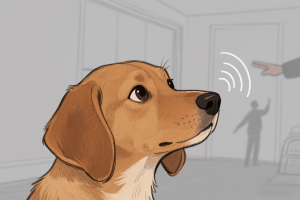

Earlier this year, a viral incident involving influencer Pan Hong took place during a live stream, where he used violent methods to bathe his Alaskan Malamute, “Ait.” These included tying its mouth shut and slapping its ears, which ultimately led to Ait’s death. Pan Hong often resorted to kicking, beating, and other aggressive actions to make dogs “behave” when they exhibited serious behavioral issues. His actions sparked widespread attention and debate. While many condemned his cruelty, there were also several supporters of his methods. Many dog owners also use punishment-based training techniques to make their dogs more obedient. But why is this approach of using physical discipline so popular? And is it really effective? To answer these questions, we must start by exploring a classic dog training theory — the “Alpha Wolf” theory.
-
The “Alpha Wolf” Theory: Disproved Over 20 Years Ago
The “Alpha Wolf” theory was first proposed by animal behaviorist Rudolf Schenkel over 80 years ago. Through observing the behavior of captive wolf packs, he concluded that there is one leader, the “Alpha Wolf,” who commands and controls the actions of the other pack members. This theory quickly gained popularity and is still believed by many people today. However, by the 1990s, scientists had already disproven the “Alpha Wolf” theory. Researchers found that wild wolf packs are actually family units consisting of parents and their offspring, where the members cooperate with each other as a family, rather than having a single dominant leader. In other words, there is no such thing as an “Alpha Wolf.” The original observations may have been skewed because the wolves were confined in small spaces, leading to abnormal fighting and dominance behaviors. Unfortunately, this flawed theory was applied to dogs as well. Since dogs are descendants of wolves, people assumed they should follow the same hierarchical structure. Early dog trainers and researchers applied the “pack hierarchy” theory, interpreting human families as “cross-species wolf packs.” They believed that dogs would try to challenge for dominance, and if the owner wasn’t the “Alpha,” the dog would not obey. Based on this theory, dog training often involved threats, punishment, and physical discipline to establish authority, making the dog obey. Trainers believed that if a dog misbehaved—barking, urinating everywhere, etc.—it was challenging the “Alpha’s” authority, and the owner or trainer would need to use harsh measures (like kicking, intimidation, or physical punishment) to make the dog understand who is in charge, ultimately leading to better behavior.
-
Did the Dog Really Become “Obedient”? It’s Actually a Breakdown of Trust
Although dogs are descendants of wolves, they have evolved alongside humans for thousands of years, and their behavior is vastly different from that of wolves. Therefore, it’s inappropriate to apply wolf-based theories to dogs—especially since the “Alpha Wolf” theory itself is incorrect. Despite this, the “Alpha Wolf” theory is still widely used in dog training. One prominent proponent of this theory is Cesar Millan, an American dog trainer known for promoting dominance-based methods. He is the host of the popular TV show The Dog Whisperer. In the show, Millan’s training methods mainly involve punishment and control techniques, such as shock collars, to make “problem dogs” more obedient. While the show brought Millan fame and fortune, it also generated significant controversy. Many professionals, including the Humane Society of the United States and renowned veterinarian and animal behavior expert Dr. Sophia Yin, have criticized Millan’s methods, stating that they are based on violence and threats, with many flaws. However, Millan has a strong base of supporters who argue that his techniques are effective, claiming that once misbehaving dogs are trained, they become obedient and well-behaved. This is the deceptive aspect of punishment-based dog training—it may seem effective in the short term, but it is problematic in the long run. Consider a family where parents only educate their children through punishment and fear. While the child might appear obedient due to fear of authority, they likely harbor resentment and mistrust toward their parents. Over time, this approach can lead to anxiety, fear, and even severe psychological issues. The same happens with dogs. A dog may temporarily “behave” out of fear and stress, but this doesn’t mean the dog understands the rules or trusts humans—it simply learns to avoid punishment. Threat-based training may suppress surface-level behavior, but it does not address the root cause, meaning the dog will not learn more positive behaviors and may even develop new behavioral problems. Furthermore, this type of suppressive training can cause negative emotions such as fear or resentment toward the owner, damaging the bond between them and making the dog less motivated to learn.

-
Dog Training Should Be Based on Trust
Modern dog training focuses on establishing a trusting, close relationship with dogs, helping them understand and follow behavioral boundaries without fear. So, how can you train a dog while maintaining a trusting, close relationship and also correcting its behavior? The most common dog training methods fall into four categories: Positive Reinforcement, Positive Punishment, Negative Reinforcement, and Negative Punishment. Here, “positive” refers to adding something, and “negative” means removing something. “Reinforcement” means increasing the likelihood of a behavior occurring, while “punishment” refers to decreasing the likelihood of a behavior occurring.Recommended: Positive Reinforcement.This method involves adding something to increase the likelihood of a dog repeating a certain behavior. For example, when a dog comes when called by name, the owner immediately rewards it (positive reinforcement), making it more likely the dog will come next time. Similarly, when a dog urinates in the designated spot, the owner rewards it with treats and praise (positive reinforcement), increasing the likelihood the dog will use that spot again. Dogs trained using positive reinforcement tend to be more confident, learn faster, and form closer bonds with their owners. Positive reinforcement should always be the first choice in training.Recommended: Negative Punishment.This method involves removing something to decrease the likelihood of a behavior. For instance, when a dog tries to bite the owner’s sleeve or push them over in excitement, the owner might turn away or leave the scene, removing their attention (negative punishment). This decreases the likelihood that the dog will try this behavior again in the future. Why is this effective? If the owner pushes the dog away, the dog might think it’s a form of play and try to engage the owner again by biting or pushing. By removing attention, the dog learns that these behaviors won’t get it the attention it seeks. Negative punishment is considered the second-best training method after positive reinforcement.Not Recommended: Negative Reinforcement.This method involves removing something to increase the likelihood of a behavior. For example, when walking a dog, the owner may tightly hold the leash until the dog walks calmly, relieving pressure once the dog slows down (negative reinforcement). However, this method is not as positive as positive reinforcement and shouldn’t be the first choice. Dogs trained with negative reinforcement tend to lack positive emotional motivation and may become tense or lose trust over time due to continuous stress.Avoid: Positive Punishment.This method involves adding something to decrease the likelihood of a behavior. For example, when a dog barks, the owner might hit or kick the dog (positive punishment). This approach is based on the “Alpha Wolf” theory and threat-based training, and should be the last resort. If you want to reduce barking using positive reinforcement, you should reward the dog for staying quiet, especially before it barks, when the stimuli (such as the doorbell or passing cars) trigger the behavior. Consistency and patience are key to training a dog to be quiet, using rewards to reinforce calm behavior over time.
In dog training, while intimidation and violence may seem effective in the short term, they often backfire in the long run. The relationship between the owner and the dog should not be based on an unequal dynamic of “leader” and “follower,” but rather on a cooperative relationship built on mutual trust. Scientific dog training methods, especially positive reinforcement, not only help dogs better understand and learn, but also strengthen the emotional bond and intimacy between the owner and the dog, increasing the dog’s trust in its owner. This creates an environment where the dog can grow up in a loving, supportive setting. Throughout this process, the most important factor is the owner’s patience and the consistency of training.