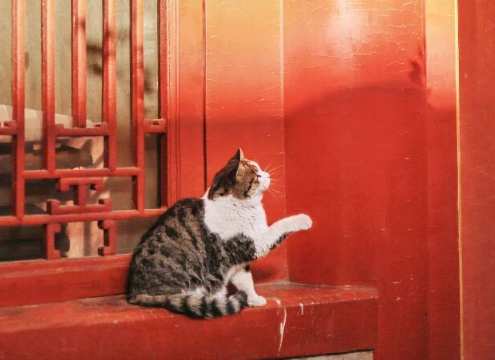
As the “imperial cats” living in the Forbidden City, the Palace Cats have attracted much attention in recent years. On one hand, there’s the image of a leisurely life captured by photographers’ lenses, and on the other, there’s the harsh reality of survival that stray cats must face. The fate of the Palace Cats is far from being as simple as just being “too cute.”
-
Finding the Imperial Cat
Just as we were about to give up, Xiaodan’er appeared. There are two inconspicuous drainage holes next to the souvenir shop and rest area on the northwest side of the Forbidden City. Photographer Hua Ge had once captured a scene here with two cats standing at the hole, peering outside. “Let’s try, but don’t expect much,” Hua Ge said. When he encountered the cats, the space outside the hole hadn’t yet been set up with sunshades and tables, so not many people were around. “When there are too many people, the cats get scared and hide far away.” Hua Ge took out some cat food, a tool he uses to attract cats across the country, “It costs about 30 to 40 yuan per kilogram, just like what I feed my own cat.” The sound of the plastic bag crinkling might have drawn attention in Beihai Park nearby, where the cats would usually come running at the sound. “The elderly people around here always carry bags of food for them. After a while, it becomes a conditioned reflex,” he explained. However, this trick didn’t seem to work for the Palace Cats. Hua Ge tried a second method: he took out his phone and played a recording of a cat’s meowing, alternating between a deep meow from a male cat and a high-pitched meow from a female. After a few rounds of meowing, Hua Ge bent down to look, but the hole remained quiet. “No luck, let’s go,” he said, but I wasn’t ready to give up and crouched down to take a few more glances. To my surprise, this time, luck was on our side. “It’s coming! It’s coming!” I shouted excitedly. From the black hole, a shadow of white and yellow slowly emerged, getting closer and closer. Although I crouched as far away as possible, I still dared not move, holding my breath in silence. The approaching figure gradually covered the dark hole and hesitated for a few seconds at the boundary between sunlight and shade. Then, it stepped forward, and a yellow-and-white cat’s round head appeared before us. “Such good luck!” Hua Ge said as he carefully approached the hole, sprinkled two handfuls of cat food, and quickly backed away. The little cat, still wary of people, didn’t dare to come out of the hole but couldn’t resist the delicious food. It stretched out its paw, slowly pulling the food closer to the hole, cautiously peeking out to eat. The cat had a white belly and an orange back, and based on its appearance, it was identified as Xiaodan’er. Xiaodan’er is usually seen in the company of other cats, but since spring 2019, the others have been missing, leaving only Xiaodan’er alone. Without companions, Xiaodan’er has become even more timid. Hua Ge set up his camera and captured this lucky moment, the second time he had photographed a Palace Cat in 2019. Since early 2018, this Shanghai-based photographer, known as “Meowwo” on Weibo, had frequently visited Beijing to photograph the cats of the Forbidden City. Beneath the imperial city, behind the red walls and yellow tiles, even the most common of Chinese rural cats seems to acquire a touch of royal elegance, appearing mysterious and proud. “To capture the essence of Beijing, the Forbidden City is the perfect place,” Hua Ge remarked. According to Shan Jixiang, the former director of the Forbidden City, there are nearly 200 cats in the Palace, but tourists only encounter a few of them in the public areas. “But there were two times that really amazed me,” said Liu Shun’er, who often spends an entire day in the Forbidden City. “One time, just before closing, the visitors were mostly gone, and the closing music began to play. Suddenly, the sound of meowing filled the air, and a bunch of kittens came out of a hole, gathering in the main hall along the central axis. It was such a cute sight.” In that moment, Liu Shun’er believed that the Palace Cats might indeed be more than just ordinary cats, perhaps possessing some spiritual quality.
-
Life in the Palace
The mystical reputation of the Palace Cats has historical roots. Some of the Palace Cats can trace their lineage back many generations, possibly with royal blood. The tradition of noble families keeping cats dates back to the Western Zhou Dynasty, and by the Tang Dynasty, cats had become widely kept in the imperial palace. Shan Jixiang once mentioned that today’s Palace Cats are officially part of the Palace’s system. While this may sound like a joke, during the Ming Dynasty, there was indeed a formal structure for the palace cats. At that time, the Palace Cats had a high status, and there was even a special “Cat Room” where servants attended to the royal cats. Ming Dynasty eunuch Liu Ruoyu recorded in Zhu Zhong Zhi: Nei Fu Ya Men Zhi that: “The Cat Room had three or four attendants who specifically fed the cats designated by the emperor. Any cat favored by the emperor was given an elevated position.” This was the kind of treatment the royal cats received. There are many true stories and legends surrounding the Palace Cats. One famous story is about Emperor Ming Shizong Zhu Houzhao, who was known for his intense love of cats. He had two favorite cats, Huamei and Shimao. Huamei was even given the title “Qiu Long,” making it the first cat in history to receive an official title. When Huamei passed away, Zhu Houzhao had it buried at Wansui Mountain, and even the coffin was made of gold. Such emperors who adored cats were rare, but keeping cats was fashionable among the emperor’s concubines. Furthermore, in traditional Chinese culture, cats are seen as feminine, mysterious, and sometimes even associated with a seductive or slightly sinister aura, which aligns with the qualities of women. Throughout history, there have been countless stories of cats and concubines competing for favor. These true stories and legends have been passed down to the present day, enriching the cultural significance of the Palace Cats. Today, the “Cat Room” no longer exists, but the Palace Cats still enjoy some fame. Some are well-known, while others quietly roam the Palace, largely unnoticed. In the strictest sense, the Palace Cats are stray cats, but they are much safer within the Palace’s enclosed area than their counterparts outside. “I’ve spoken with some longtime employees, and there’s always been a tradition of caring for stray cats in the Forbidden City,” said Ke Cha. “Perhaps when older employees retire, they pass this on to the younger ones, and the tradition continues from generation to generation.” Ke Cha explained that many of the Palace Cats have known ages, and their family relationships are well-known. For example, everyone knows which female cat gave birth to which male cat’s kittens. This is because there are dedicated people who take care of them and are very familiar with the cats. “The average life expectancy of a typical stray cat is about three to five years, but many of the Palace Cats live to be over ten, which is truly remarkable,” Ke Cha said. While the Palace Cats might appear prestigious, their lives are not without challenges. Without the “Cat Room,” the current Palace Cats rely on the care of loving staff.
-
The Mission of Wei Yingluo
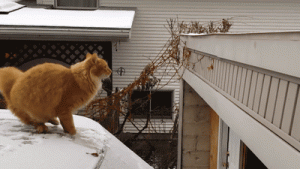
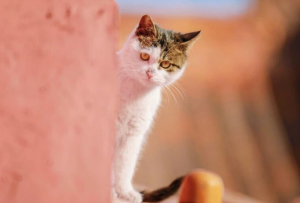
Ke Cha introduced me to Lu Ping, the head of the “It Fund,” China’s only accredited animal protection foundation. Since 2018, the “It Fund” has been providing assistance to the Palace Cats. Their mobile veterinary clinic regularly visits the Forbidden City to help care for the cats, performing sterilizations and vaccinations. “Each department gathers a few cats that need to be sterilized, and there are also a dozen or so that need vaccinations. When we have enough, our mobile clinic can make a trip,” Lu Ping explained. She recalled an amusing scene she witnessed during one visit to the Forbidden City: “When Fu Qiang called in the group, the people who take care of the cats in different departments rushed toward the clinic. Some rode bikes with cat carriers on their backs, some used tricycles to transport the cats, and some even rode ahead while someone else followed carrying cages. Everyone was bringing their cats for vaccinations, and we had to set up a waiting area. It was such a loving scene.” However, compared to this heartwarming sight, what truly left a deeper impression on Lu Ping, and what might change the fate of the Palace Cats and other stray cats, was an incident that could be called a “lucky encounter.” In the second half of 2018, the “It Fund” mobile clinic came to the Forbidden City for sterilizations, vaccinations, and regular check-ups. The vehicle entered from the East Hua Gate, and the team stopped to capture a yellow cat that was known for being elusive. After searching for a while in a bamboo grove, they couldn’t find the cat. But instead, they encountered its mate. Lu Ping explained, “It was a tortoiseshell cat. As we approached, we saw a litter of kittens around her. The kittens had been attacked by a weasel or something, and most of them were already dead. There was only one yellow kitten left, barely alive, with its head and lower jaw torn open, looking like it wouldn’t survive much longer.” The team immediately took the kitten to the mobile clinic and rushed it to a pet hospital’s intensive care unit. After four or five days, the kitten miraculously survived. “Wasn’t that lucky? If we hadn’t happened to run into the mobile clinic, it might not have made it,” Lu Ping said. At that time, Yanxi Palace, a popular Chinese drama, was still trending, and Lu Ping jokingly named the kitten Wei Yingluo, though she later realized that the kitten was actually a male. Wei Yingluo stayed in the pet hospital for a while, and as Lu Ping considered the kitten’s future, she thought adoption would be the best option. If not, she’d have to return it to the Forbidden City. Liu Yingzi, a donor to the “It Fund,” saw the story of Wei Yingluo and couldn’t sit still. “He’s so small, and after suffering such a serious injury, if he goes back, he probably won’t survive,” Liu Yingzi thought. Since she already had six cats and two dogs, she wasn’t worried about taking in one more cat. As Wei Yingluo grew, his personality began to show. “He’s definitely different from the average cat,” Liu Yingzi remarked. “Not just me, but even the pet doctors who know him well say the same.” Although he looked like an ordinary orange cat, once Wei Yingluo entered the house, he was very well-behaved. When they called his name, he would respond immediately. This was his refined side. But the wild side of Wei Yingluo could sometimes be overwhelming. Once, when Liu Yingzi took him to the pet hospital for a check-up, Wei Yingluo wouldn’t let the doctor touch him. He scratched and “scolded” the doctor, scaring everyone. “I’ve never seen a cat like this,” said the doctor. “He’s so determined to resist, staring at you with those eyes. It’s really something.” As a stray cat with royal cat lineage, Wei Yingluo had a strong hunting instinct. At just seven months old and after being sterilized, he ran around the neighborhood, catching birds and mice. Even the more experienced older cats couldn’t match him. “He’s just 10 months old now, but he’s already the heaviest and biggest cat in our family,” Liu Yingzi added. Although Wei Yingluo lives with six other cats, Liu Yingzi’s “training” of him is completely different. Despite his wild nature and foul temper, Wei Yingluo knows how to be “a distinguished cat.” He’s learned to “sit,” shake hands, and even behaves well in crowds. Liu Yingzi and Lu Ping both agree that Wei Yingluo, as a Palace Cat, could one day become a “PR cat.” His case is a typical example of a stray cat receiving help and finding a loving home. Therefore, Liu Yingzi consciously began training Wei Yingluo from the start. She takes him to work every day to help him become desensitized to crowds and interact better with people. Learning commands like “sit” and not eating random things are essential for a cat with such a famous background, ensuring it won’t harm others or be harmed when out in public. Plus, his ability to “shake hands” makes him less likely to be annoyed by children who may grab his tail. It’s safe to say that Wei Yingluo has already become a cat who can handle the spotlight. He can lie still in a box, letting pet-loving adults and children stroke him without a fuss.
Sometimes, before heading out, Liu Yingzi would have a little chat with Wei Yingluo. “Wei Yingluo, don’t run off. When you’re with me, you’re the Palace Wei Yingluo. If you run outside, you’ll just be another stray orange cat, do you understand?” Every time Liu Yingzi had this “conversation” with Wei Yingluo, she felt that this unique orange cat truly understood her words.