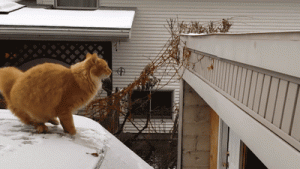
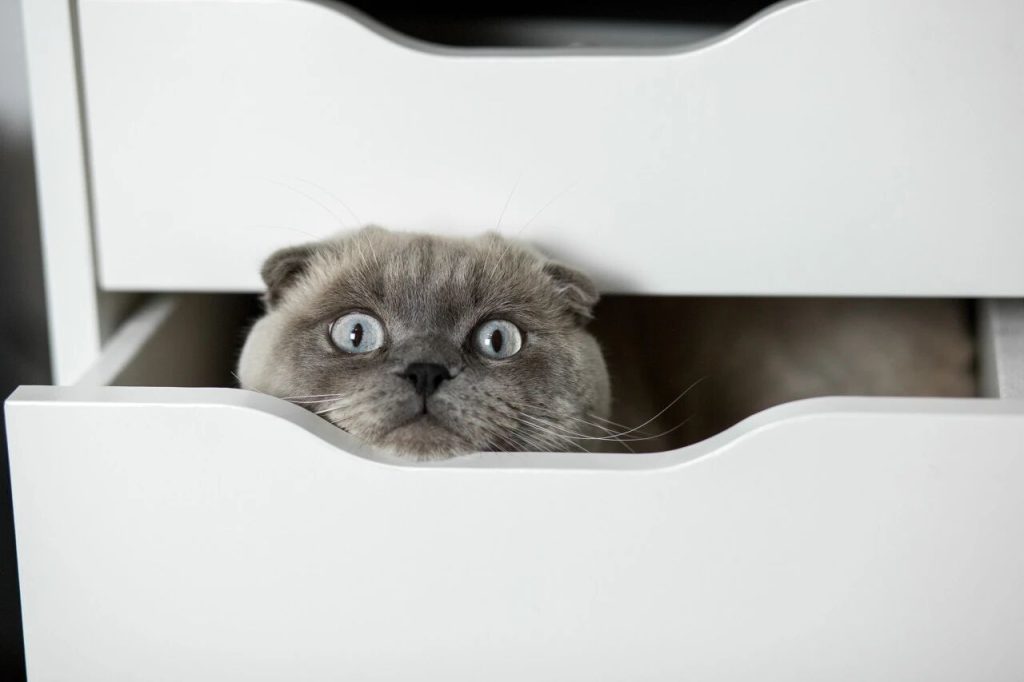
There’s a saying that “cats are liquid,” which might sound unbelievable, right? In fact, it’s not just a joke. In 2017, M.A. Fardin, winner of the Ig Nobel Prize in Physics, discussed the physical state of cats from the perspective of rheology. He explained that matter can behave as either a solid or a liquid depending on the time frame of observation. This concept is measured by the “Deborah Number (De),” a parameter first introduced by Professor Marcus Reiner from the Technion-Israel Institute of Technology. The Deborah Number is used to measure the viscoelastic properties of fluids.In short periods, a cat behaves like a solid, as it maintains its shape. However, over longer periods, a cat behaves more like a liquid, able to slowly flow and adapt to the shape of its container—just like how a cat can “flow” into a bowl. Scientists have also observed cats exhibiting liquid-like behavior on different surfaces. For instance, on rough surfaces, cats tend to “spread out,” while on smooth surfaces, they “slide.”Overall, cats are considered “active fluids” because they can move and adjust their shapes independently, unlike typical passive fluids that need external forces to move them. This unique ability makes their liquid-like behavior even more fascinating and complex.
-
Why Can’t Humans Slip Through Small Openings Like Cats?
The key to cats’ liquid-like nature is their extreme body flexibility. For humans, while our heads may fit through small spaces, our bodies often can’t follow suit—due to the collarbone. The width of our shoulders is determined by the length and position of the clavicles, which are fixed structures in our bodies. On the other hand, cats have a highly reduced clavicle, unlike humans, so they don’t face this limitation. Without the collarbone restricting their movements, cats can compress their bodies to a remarkable degree, allowing them to squeeze through narrow gaps. Additionally, a cat’s spine consists of 30 vertebrae, fewer than in humans. Studies show that a cat’s spine is highly flexible, especially in the thoracic region (T4 to T11), allowing for significant twisting movements. These spinal properties allow cats to quickly twist or jump, making them incredibly adaptable to small spaces.Muscle and ligament flexibility is also crucial. In 1981, scientists conducted an experiment to observe how cats’ muscles work when jumping. They found that key muscles like the semitendinosus, gastrocnemius, and long toe extensors were highly coordinated during jumps. These muscles were monitored using electromyography (EMG) to capture activity in different phases of the jump. The research revealed that cats’ joints maintain a wide range of motion, which helps them achieve high jump heights and adjust their posture when navigating through tight spaces.

-
Do Cats Realize They Are “Liquid”?
Do cats know that they can fit through narrow openings like liquid? In 2024, Péter Pongrácz conducted an experiment involving a special setup resembling a narrowing doorframe. He gathered 30 cats of various ages, sizes, and breeds to see if they could assess their ability to pass through gradually shrinking gaps. The goal was to determine if cats could recognize their own body size and plan accordingly or if they simply “tried it out.” However, cats are known to be notoriously “difficult” subjects in experiments. At one point, Pongrácz found a cat escaping into a ventilation duct! Imagine the scene: the scientists were all set with a carefully designed narrow opening, the cat’s owner was standing on the other side with a treat, but the cat simply ignored them, licking its paws as if mocking the “silly humans.” The only rule for the cat was, “Only participate if you feel like it!”At first, when the opening was wide enough, almost all the cats could easily pass through. However, as the gap narrowed, some cats stopped and began to carefully assess whether they could make it through. They gently touched the edge of the opening with their whiskers or nose, seemingly evaluating their ability to squeeze through. Researchers found that when the opening was 12 cm wide, about 70% of cats attempted to pass, but when it shrank to 7 cm, only 15% of cats still tried. Clearly, when the opening’s width dropped below 10 cm, cats became more cautious.Interestingly, when the opening was less than 15 cm high, cats were hesitant. Scientists recorded their behavior: when the opening height was greater than 20 cm, almost all cats continued trying to pass through. However, when the height dropped to 15 cm, over 80% of the cats stopped, showing significant hesitation. Some cats even chose to bypass the obstacle or gave up altogether. Interestingly, younger or smaller cats were more daring, while older or larger cats tended to be more cautious. Weight also played a role: cats over 5 kg were more likely to give up when the opening was less than 9 cm wide, whereas cats under 4 kg still tried to pass through even when the gap was only 6 cm.In short, some cats do indeed act like “liquid,” squeezing through almost any opening. In a sense, if cats are “liquid,” they are a type of liquid that is “height-restricted but width-unrestricted.”
In response to the same challenge, dogs approach the situation quite differently. A few years ago, Pongrácz recruited several dogs for a similar experiment. The research revealed that when dogs encounter a small opening that might not be wide enough for them to pass through, they slow down and hesitate, sometimes opting to take a detour. Dogs demonstrate a clear awareness of their body size and make decisions based on the opening’s dimensions as they approach it. This contrast highlights the differences in body awareness between the two animals. Dogs tend to rely more on a strong understanding of their size, especially in tight spaces, while cats rely more on flexibility and a trial-and-error strategy when navigating narrow openings. As Pongrácz put it, “Cats might be liquid, but they also know when to stop flowing.”