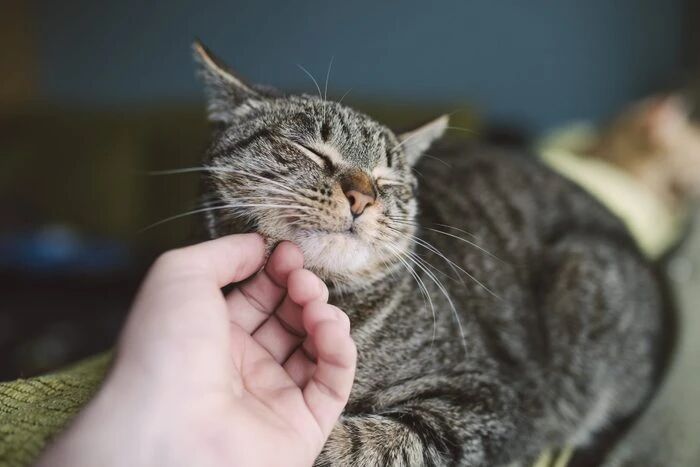
On nights when insomnia keeps me awake, melatonin, heavy blankets, and white noise never seem to help. There’s only one remedy for my suffering: my cat Calvin lying on my shoulder, purring me to sleep. For those of us in the “purring club,” the reason is clear. A cat’s purr is like a warm cup of tea, a crackling fire, and freshly baked cookies, all wrapped in a wool-lined hug. It’s the soothing sound of a babbling brook, a comforting melody; it’s like the first sip of coffee at dawn.Dr. Wylanie Song, a veterinary behaviorist at the San Francisco SPCA, explains that purring is a symbol of emotional fulfillment. It indicates that “we are making our pets happy,” and that feeling is truly wonderful. Yet, despite being one of the most recognizable sounds in the animal kingdom, a cat’s purr remains one of its greatest mysteries.Robert Eklund, a phonetician and linguist at Sweden’s Linköping University, says, “No one really knows how purring is produced.” Experts are also unable to accurately explain the meaning behind it. Cats purr when they’re happy, but they also purr when they’re anxious or frightened, during labor, or even when they’re nearing death.
-
Cats May Be the Most Mysterious Creatures Invited into Our Homes, and Their Purrs Are One of the Most Mysterious Sounds They Make
At least, there’s some agreement on what purring actually is. Strictly speaking, it’s a rhythmic, rumbling vibration that aligns with the typical animal vocalization pattern. The sound is produced both when the cat exhales and inhales, with no pause in between. Cats purr with their mouths fully closed, almost like tiny feline ventriloquists. The frequency of the sound emitted from their body ranges from about 20 to 150 Hertz. As early as the 1960s, a scientist proposed that purring was a result of blood flowing through the vena cava, the blood vessels that carry blood back to the heart; however, this theory was later proven to be incorrect. Many animals can mimic the purring sound, including bears and guinea pigs. But only a few animals can produce a true, bubbling, purring noise. Aside from domestic cats, the African native animal, the civet (which looks like a small cat), is also capable of purring. Other smaller members of the wild cat family, such as bobcats and ocelots, can also purr.
-
Scientists Have Yet to Find Evidence that Any Cat Can Purr and Roar at the Same Time
Scientists are unsure what separates purring from non-purring sounds. It could be related to the length, shape, or thickness of the vocal cords in certain species, or the structure of the surrounding tissues. It may also have something to do with the stickiness of the hyoid bone (a U-shaped bone in the throat). Or, perhaps, the reasons are unrelated to any of these factors. Studying purring is not easy, as cats generally don’t like to purr in the presence of researchers or in laboratory settings. Whatever the mechanism behind purring, it seems to be an innate ability for some felines. They begin to rev up their tiny engines just days after leaving the womb, even before they can see or hear. According to Hazel Carney, a feline veterinarian and purring expert from Idaho, kittens and their mothers seem to use purring as an early form of communication, exchanging important information like “I’m hungry” or “Hey, mom’s here.”
-
But in Less Pleasant Situations, the Purring Engine Can Also Kick In
Mikel Delgado, a feline behavior expert from California, told me that she once had a cat that purred at the vet’s office. Dr. Song even heard purring sounds when inserting a catheter into a cat patient. Experts can only speculate on the reasons behind this. Carney shared that for some animals, purring might be a vocal “twitch,” similar to nervous laughter. Cats might also use it as a signal of distress or a cry for help to anyone nearby. Or, according to Dr. Jill Kavanaugh, a veterinarian and big cat expert at the University of Wisconsin-Madison, purring in dire situations may serve as a form of self-soothing. Carney had a cat named “Electron” that exhibited this behavior. Purring could be a way for cats to trick their stressed bodies into entering a more relaxed state. Early research in the first decade of the 21st century suggested that purring could even help cats ease pain. The vibrations from purring might accelerate the healing of wounds or fractures. Eklund told me this idea isn’t entirely far-fetched. Vibration therapy has shown some potential in animals like rabbits. Even NASA conducted studies on this to counteract bone loss in astronauts after long-term space missions. Carney shared that many cat owners “swear that their cats saved their lives” when they purred next to them while they were sick in bed. Although cats can produce purring vibrations at frequencies similar to those used in therapeutic vibrations, there’s no research focusing on big cats. Kavanaugh told me, “I don’t think we’ve ever done a study where we say, ‘I let a cat purr on my broken leg for 15 minutes every day, and I healed faster than others.’” As for how purring affects the cats themselves, we have no studies on that either.
-
Meowing May Be a Little Mystifying Too, but It Has More Obvious Logic
It’s not hard to distinguish Calvin’s “Feed me, I’m starving!” whine from his “Why am I in this cat carrier?” howl. Carney, who has heard all kinds of purring sounds over the years, explained that the same variation likely exists within purring itself. Satisfied purrs are often deeper and more pleasant, while anxious purrs tend to be higher-pitched and more piercing. A study a few years ago found that humans can identify “begging” purrs from their pets—this is a sharp, urgent sound cats make when they’re searching for food. But such distinctions are hard to make, especially when dealing with unfamiliar cats. Kavanaugh noted that even her veterinary students at the clinic sometimes struggle to tell them apart. Unlike many other cat sounds, purring is difficult for humans to replicate. It’s easy to mimic a cat’s meow; “It’s like a very basic ‘pidgin’ cat language,” Eklund said. But purring? Our brains and throats aren’t designed to make that sound. To me, it’s a gentle tragedy: the deep purrs of my two cats—Calvin and Hobbes—are messages of love, joy, and happiness. They’re tactile and auditory feedback from my touch. They’re symbols of a love I can receive but never truly return. Specific devices and soundtracks can offer alternatives. Some veterinary clinics play “cat music” in exam rooms, with bass tracks designed to soothe cats. Delgado mentioned a shelter she worked at that purchased surrogate cat care machines, which played synthetic purring sounds for abandoned kittens. Purring enthusiasts can even stream 30-minute episodes of cat purring on podcasts, like one from a ginger cat named Bilbo from Ireland.
Purring is a language barrier we’ve yet to overcome. In some ways, it’s quintessentially cat. Humans have spent generations breeding dogs to express emotions in very human-like ways—with soulful eyes and wet, smiling mouths. Yet, cats remain so subtle and refined; their faces haven’t evolved to make obvious expressions but are instead set to the default “serene cat face.” Even compared to other cat vocalizations, the purring sound is delicate and intimate. This form of communication depends on the closeness, intimacy, and understanding between the person and the cat. Sometimes, it may even depend on the cat’s understanding of our needs.