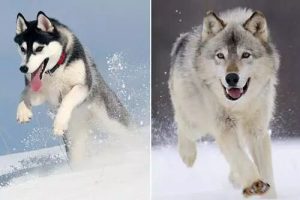
“Who’s a good boy?”For thousands of years, people around the world have asked this question in countless languages.We instinctively cast our loving gaze on any adorable creature, bring it home, and then try to make it love us back.But domestication is not just something humans impose on other species.Animals can adapt to us—and change themselves—too.The domestication of dogs has sparked intense debate.Did early humans select the most gentle members from ancient wolf packs and bring them home as companions?Or were there wolves that were naturally more tolerant of humans, slowly creeping closer to feast on leftover food scraps?One of the central questions in this debate is whether the math adds up.Was there enough time for an entirely new species to emerge from human-trash-scavenging wolves?Did the transformation from wolf to dog really happen within the timeline we assume?A new set of mathematical models published on February 12 in Proceedings of the Royal Society B: Biological Sciences suggests that the calculations are sound.If conditions were favorable, wolves could have evolved into dogs entirely on their own—within roughly 8,000 years.
-
How Humans May Have Steered the Direction of Evolution
Humans and dogs have lived side-by-side for at least 30,000 years, and many theories exist about how proud, wild wolves eventually became tiny, trembling Chihuahuas.“There is strong evidence that artificial selection has existed across human cultures within the last 15,000 years,” said Alex Capaldi, a theoretical ecologist at James Madison University in Virginia. In other words, people once actively selected traits in dogs instead of letting evolution run its natural course.But what happened 15,000 years ago? No one truly knows. Early humans may have bred wolves with calmer temperaments to assist with hunting.“I don’t think ancient hunters could have realistically partnered with large predators—those predators would have seen the hunters as competitors, not teammates,” said Katherine Lord, an evolutionary biologist at UMass Chan Medical School, who was not involved in the new study.Perhaps ancient humans simply did what we still do today—pick up a cute baby animal and bring it home. According to this “adopt-a-pup” hypothesis, a small, isolated group of naturally friendlier wolves would breed among themselves, rapidly kick-starting human-driven selection.
-
The ‘Self-Domestication’ Theory
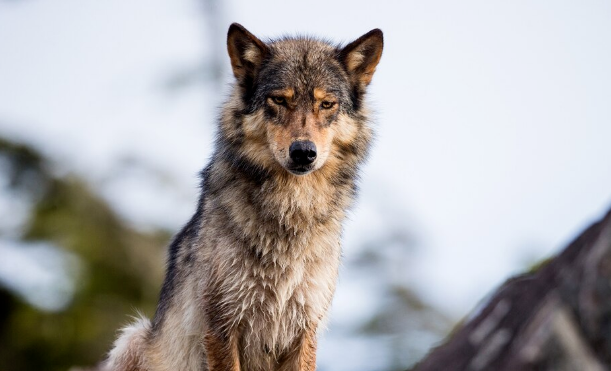
But what if ancient wolves chose a human-centered lifestyle on their own? Wolves that successfully scavenged from human waste may have been more tolerant, trading aggression for easy, reliable food. These human-associated wolves could have become isolated from other wolf packs, breeding only with similarly tolerant wolves—and, somewhere along the way, learning to wag their tails.This theory is often called proto-domestication, self-selection, or the scavenger wolf hypothesis. Capaldi became intrigued by it while watching the reboot of Cosmos, hosted by Neil deGrasse Tyson. In one episode, the astrophysicist sits by a campfire and tosses an old bone to a wolf—a vivid illustration of this idea.Capaldi was surprised. He had always heard the traditional narrative that humans created dogs from wolves.“I wanted to understand the other side of the story,” he said.He stepped into a controversial debate. One major criticism of the scavenger wolf theory is that evolution should take far too long if wolves were only scavenging and selectively mating within wolf populations. David Elzinga, a mathematical ecologist at the University of Wisconsin–La Crosse, argues that this is exactly where mathematical models can help.“I don’t think mathematical models have ever truly taken the stage in this debate,” Elzinga said. Models are not real ancient wolves or real humans, but simplified representations of the natural world. “I think they can do a lot.”

-
A Model of Mating Among Gentle Wolves
Capaldi, Elzinga, and their colleagues used an agent-based computer simulation to calculate how long it would take for a new species to emerge—specifically, how long it would take for a population of ancient scavenger wolves to diverge into early dogs.They ran models where gentle wolves mated only with each other, and models where they did not. They also tested scenarios where the amount of available garbage stayed constant—a proxy for stable human population size—and scenarios where garbage increased, meaning a growing population that produced more waste.Each model ran for the equivalent of 15,000 virtual years.Across these models, divergence occurred around 37% of the way through the simulation. When tame wolves mated with similarly tame wolves, dogs diverged from their wolf relatives after roughly 8,000 years, with the transition lasting over 3,400 years and often continuing right up to the model’s time limit.Whether human-generated food stayed constant or increased, divergence still occurred.But when gentler wolves mated freely with more aggressive wolves, no new species ever emerged.Bridgett vonHoldt, an evolutionary biologist at Princeton University who was not part of the study, believes that mating among gentle wolves may have simply been due to proximity.Although the idea is often labeled “self-domestication,” vonHoldt points out that wolves who tolerate humans spend more time near human settlements and benefit from it—making this a form of natural selection.She also noted that a small number of genes are associated with “hyper-sociability” in animals; adding such genetic variants into future models might better represent early dog populations.“Some people argue the scavenger wolf hypothesis would require far more time than is realistic,” Lord said. “This paper offers evidence in the opposite direction.”
-
New Clues in an Old Debate
Lord emphasized that this does not prove wolves definitely became dogs by scavenging. “But it does provide evidence supporting the scavenger wolf hypothesis.”However, other criticisms remain.Mietje Germonpré, a paleontologist at the Royal Belgian Institute of Natural Sciences, pointed out:“Archaeological evidence shows that in the late Paleolithic, modern humans prevented large carnivores from approaching their camps to protect stored food and waste.”So even if wolves had enough time to form human-associated groups, early humans might have driven them away.Capaldi noted that the study’s results do not claim scavenging was the only path to domestication—just that, mathematically, it was plausible.
Humans may have played a role, but dogs were equally important.“A lot of different processes were happening,” he said. “The real question may not be which theory is correct, but which one played the bigger part.”No matter the answer, the findings remind us that domestication is not simply something humans impose on another species. It is a two-way street—one where both species move closer to each other. And in this case, it marked the beginning of a remarkable new friendship.