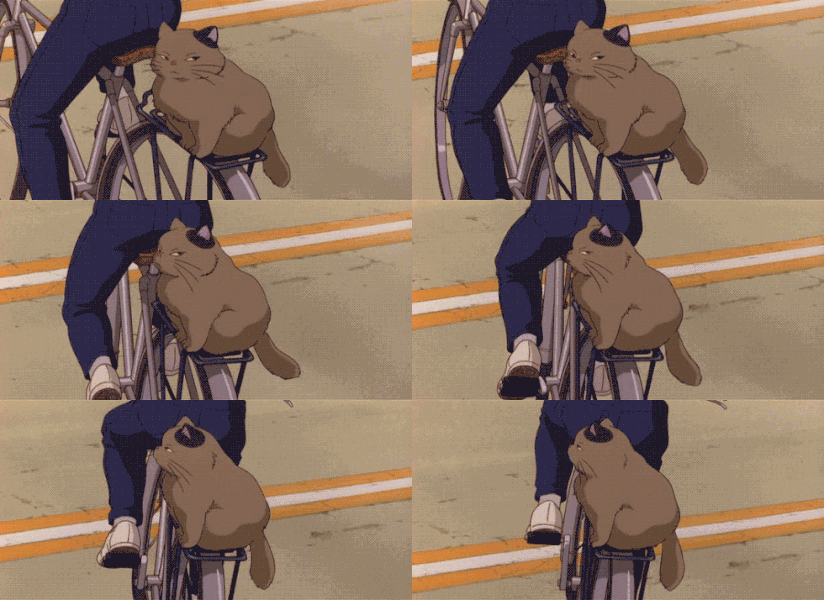
Have you ever tried lying in bed, calling your cat over, hoping it would come snuggle with you?Based on my own experience, unless your feline overlord wants to come over, you can shout until your lips go dry and it will still end in failure…So when you call your cat and it doesn’t respond—is it pretending not to hear, or is it actually clueless?In today’s world of global cat obsession, social media is overflowing with humans documenting their addiction to felines—their fluffy, squishy bodies, their sparkling eyes, their graceful and agile movements. Even a random photo or video is enough to make soft-hearted girls squeal and tough guys tear up.But at the same time… their cold indifference also leaves people completely confused.I believe many cat parents have had the same experience:Whether you call them with enthusiasm or scold them in anger, your cat always gives you that “I heard nothing, I saw nothing” expression.Which makes you wonder—do they truly not realize you’re talking to them,or are they just pretending not to hear?
-
Scientists Want to Know Too
The mystery of “why cats don’t respond when called” isn’t just something that haunts countless cat owners—it has also attracted the attention of scientists from Japan, one of the world’s most enthusiastic cat-loving nations.Researchers from the University of Tokyo conducted an eight-month covert study observing how 20 household cats reacted to recordings of their owners’ voices. Their goal? To determine whether cats ignore us on purpose, or if they genuinely can’t help it.In the experiment, after each owner left the cat’s line of sight, the scientists played audio clips in sequence: first a stranger calling the cat’s name, then the owner doing the same.The results showed that 50–70% of cats responded more noticeably to their owner’s voice—such as by moving their ears or turning their heads—indicating that most felines can indeed recognize their owner’s voice.Exciting, right?Well… here comes the twist.Another major finding was that even when cats recognized their owner’s voice, they only took further action—like meowing or walking over—about 10% of the time.In short:Yes, your cat knows you’re calling.No, your cat simply… does not care.

-
It All Starts With the Origin of Domestic Cats
The experiment results may stir mixed feelings, but what really matters is why cats behave this way. In the animal world, behavior is deeply tied to evolutionary origin.Take dogs, for example. From early human civilization, dogs were trained by humans and learned to follow commands.Cats, on the other hand, have a very different backstory.Around 9,000 years ago, the ancestors of modern cats first approached human settlements. As agriculture developed, cats began living near human homes to hunt mice and small animals that fed on stored grain.In other words, cats were not “domesticated” by humans—cats domesticated themselves.They chose us, not the other way around.Some scientists further suggest that a cat’s “reserved” personality is actually a self-protective mechanism. In the wild, cats are solitary animals. Without the protection of a pack, any injury or danger must be faced alone. Showing vulnerabilitycould attract predators.Over time, cats evolved what we now call their “emotionless poker face”—a neutral expression that hides weakness.A classic example is their tolerance to pain. Cats often endure discomfort quietly, and by the time symptoms become visible, the condition may already be severe.So even though modern cats have adapted to live with humans—interacting with us, relying on us, and enjoying our care—they still retain that ancient pride:“Hmm? Human? What’s that? Is it edible?”
-
They Still Love You
But a cat’s “coldness” has never stopped devoted cat parents from tirelessly guessing their feline’s divine intentions. In addition to interpreting every ear twitch and tail flick, rapid advances in technology have opened new doors to understanding these fluffy enigmas.Recently, Professor S from Arizona, USA, has been developing a device that uses AI to record and translate the calls of wild prairie dogs. He believes this technology could eventually be adapted to pets—including the notoriously hard-to-read cat.His long-term dream is to enable real “dialogue” between humans and animals:“Ginkgo, Daddy’s home! Did you miss me—?”“Meow! (Uh… did Daddy just sneak a bite of grilled noodles?)”“Qiaomai, come here, let Mommy hold you…”“Meow?”
Just as one of the researchers in the study put it:“Even though cats appear completely unfazed, their owners remain endlessly enthusiastic about them. And the deeper reason behind this behavior is still an unsolved mystery.”