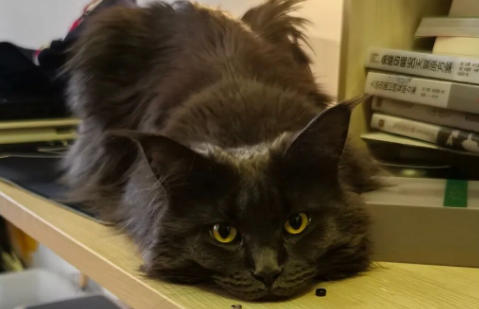
A girl who is about to be murdered is doing her laundry, and casually skins the fur off her pet cat and throws it into the washing machine along with her clothes — if you’ve watched the highly acclaimed 2023 sci-fi film Mars Express, this detail probably stuck with you. In the movie, the girl’s pet cat is actually a robotic cat.If a product like this ever came to market — a robot cat indistinguishable from a real one, able to play with you, requiring no feeding, no litter box cleaning, no vet visits, never zooming around the house at 3 a.m., and even having machine-washable fur — many people would no doubt be tempted.Of course, with current technology, creating such a lifelike robotic cat is still pure science fiction. But as cats continue to rise in popularity, their role in human life grows more significant. “Cat-obsession culture” has become a global phenomenon.So what will “cat-petting” look like in the future? What kinds of cats will people interact with? And besides simply “petting cats,” how else will humans live, bond, and play with cats?
-
From Semi-Domesticated to Fully Domesticated: The Future Evolution Path of Pet Cats
Dogs are one of humanity’s most successful domestication stories, with an astonishing diversity of breeds. From the tiny and delicate Chihuahua to the majestic Great Dane, different dog breeds vary dramatically in size, appearance, and temperament.Cats, however, are very different. Although we now see many “breeds” of pet cats, compared with dogs, cats are still not a fully domesticated species. Cats choose to live with us voluntarily.Their ancestor, the African wildcat, started associating with humans over 10,000 years ago when early agricultural societies stored grain in settlements—grain that attracted mice, which in turn attracted wildcats. Over time, cats and humans formed a mutually beneficial relationship.Unlike dogs, which have undergone strict and intensive selective breeding for thousands of years, humans placed very little selection pressure on wildcats. Modern house cats and wildcats are genetically almost identical. Your chubby orange tabby at home could return to the wild and likely survive on its own—humans have barely altered cats’ natural behaviors.There is an interesting example:Under current U.K. law, cats are defined as “Free Spirits.” This means domestic cats are legally allowed to roam freely; unlike dogs or other pets, they don’t need to be closely restricted, and owners are not liable for damages caused by a wandering cat. (Editor’s note: We do not encourage free-roaming cats.) British law essentially sees cats as their own masters, living with humans by choice.The reason humans never “fully” domesticated cats is simple: people never demanded much from them. For over ten thousand years, a cat’s primary job was to catch mice. As long as they could do that, humans had no need to modify them further.But today, in an industrialized society, more and more people keep cats purely as pets. As a result, we’re seeing all kinds of oddly shaped, uniquely featured cat breeds emerging—marking the beginning of cats walking the same path dogs did. Human demand for diversified feline traits will inevitably push pet cats into deeper stages of domestication.Anyone familiar with animal domestication history may know the famous Russian silver fox experiment. In the 1950s, Soviet scientist Dmitry K. Belyayev bred foxes in Novosibirsk and, through strict artificial selection, managed to create human-friendly foxes in only ten generations. Later research showed the initial foxes he bought weren’t truly wild but came from captive breeding programs, already selected for decades. However, this doesn’t undermine the core point:With modern technology, humans can domesticate diverse animal breeds in a very short time.This is exactly the direction the pet cat industry is moving:Breeding cats with more distinct appearances and personality traits.Today, we already see long-haired, medium-haired, short-haired, even hairless cats; large, medium, and tiny cats. In the future, we may see giant cats resembling caracals or lynxes—or palm-sized “micro cats,” similar to teacup dogs.With continuous advancement in genetics and reproductive technologies, differences in cat appearance and temperament will become even more pronounced, meeting increasingly individualized human preferences.But there is another side to this story.As urbanization accelerates, those cats that don’t become customized pets—cats living freely in cities—are facing new environments that push them toward new evolutionary directions.One example comes from Colombo, Sri Lanka, where fishing cats (a wild feline species) are adapting impressively to urban life. They hunt using the city’s canal system and learn to navigate busy roads. Although fishing cats are not domesticated, their rapid behavioral adjustments—such as using human-built infrastructure and avoiding peak human activity—suggest dynamic changes in gene expression. For instance, navigation-related genes (such as BDNF, linked to spatial memory) may be selectively activated in urban environments, helping them map complex movement routes.Similarly, urban stray cats are evolving more complex social strategies. In cities with abundant food sources, they must interact with humans and many fellow cats. This gradually pushes them toward semi-social or group-living behaviors—even though wildcats are strictly solitary animals.So, if you keep multiple cats at home, have you noticed how your cats interact with each other?
-
Talking Cats: Technology as the Bridge for Cross-Species Communication
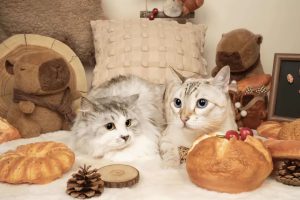
In many works of fiction, we often encounter talking cats. For example, Nyanko-sensei from Natsume’s Book of Friends can not only communicate with humans but also wields powerful spiritual abilities. Another example is Shamisen, the male calico cat from The Melancholy of Haruhi Suzumiya, who was literally created according to the wishes of the “godlike” Haruhi.Of course, in the real world, no one truly wants a cat that speaks human language or possesses human-level intelligence. Even if technology made it possible, such a creature would likely fall into the uncanny valley and raise ethical and social problems.However, with the rapid development of large language models and artificial intelligence, translating cat communication into human-understandable language is no longer a distant dream.In the relatively near future (for example, within five years), we may see the emergence of an intelligent cat communication device—a portable gadget that can monitor a cat’s vocal sounds, body movements, and facial expressions in real time. Using advanced AI algorithms, it would convert these signals into human language.For instance, when a cat meows “meow-meow,” the device might interpret it as:“I’m hungry,”“I want to play,” or“I’m feeling a bit unwell.”At the same time, the device could work in reverse—translating human language into sounds or signals that cats understand—enabling true two-way communication between humans and feline companions.In addition to language translation, such a device could continually monitor a cat’s physical and psychological state. By collecting data on heart rate, body temperature, and respiration through embedded sensors, AI could analyze these indicators and send alerts whenever abnormalities arise.For example, if the cat’s heart rate remains abnormally fast, the device may warn the owner that the cat is stressed or potentially sick, recommending a veterinary visit.A more ambitious concept involves integrating brain–computer interface (BCI) technology into the device. BCIs can read neural signals from the cat’s brain, providing deeper insights into its thoughts and emotions.For instance, when a cat sees a toy it loves, the excitement-related neural signals could be captured by the BCI and translated into information for the owner. This would allow humans to understand their cats’ preferences with remarkable precision and interact more effectively.
-
Precision Breeding: Gene Editing and the Rise of Customizable Cats
In the mid-term future (within the next 10–20 years), gene-editing technologies may replace traditional breeding methods, opening a new path for the development of future pet cats by enabling precise control over feline traits.On one hand, gene editing can be used to remove undesirable traits from cats—especially genetic diseases commonly found in certain purebred cats. For example:Polycystic kidney disease (PKD) is widespread among Persian cats.Hypertrophic cardiomyopathy (HCM) is frequently seen in Maine Coons.By modifying disease-related genes in cat embryos, scientists could eliminate these conditions at the root, allowing cats to grow up healthier.On the other hand, gene editing can enhance the traits humans like in cats. For example, for people who love cats but are allergic to Fel d 1—the protein found in cat dander and saliva (spread all over the body when cats groom themselves)—gene editing could produce hypoallergenic cats that won’t trigger human allergies.For fans of long-haired cats, gene editing could amplify long-hair expression, letting your cat grow such luxurious fur that you could practically knit a sweater from it.Similarly, coat colors, patterns, and eye colors could all be customized through gene editing.For special needs—such as owners who prefer cats that never go into heat and cannot reproduce (similar to many sterile genetically modified crops)—gene editing can make that possible. This would prevent accidental overbreeding and allow owners to focus on companionship without reproductive concerns.Once these technologies become widely available, buying a kitten might become as simple as shopping online: consumers choose from a list of preset “trait options” and customize their very own one-of-a-kind cat.
-
Why Own a Real Cat? The Rise of Virtual and Bionic Pets
Returning to the opening example of the machine cat in Mars Express: in the more distant future (20 years from now), advancements in materials science, artificial intelligence, and mechanical engineering could make it entirely possible to create robotic cats whose appearance, texture, and behavior are almost indistinguishable from real cats.Such robotic cats would offer numerous advantages.They wouldn’t trigger human allergies;they wouldn’t need food or litter cleaning, reducing the daily burden on owners;they wouldn’t go into heat or exhibit disruptive behaviors during mating seasons.Through built-in AI programs, a robotic cat could mimic classic feline behaviors—such as seeking affection, playing, or curling up to sleep—providing companionship nearly identical to a living cat.If we go further and give robotic cats functional abilities similar to Doraemon, they might not only accompany their owners but also assist with daily tasks—reminding you of your schedule, helping turn appliances on or off, and even managing parts of your smart home. Such a robotic cat would undoubtedly become a valuable partner in everyday life.Electronic pets, meanwhile, are not a new concept.Many people still remember the virtual pet devices that became a worldwide craze in the 1990s—simple two- or three-button toys that made children obsess over feeding and cleaning their digital companions.If electronic pets evolve today, obvious upgrades would include hyper-realistic CGI models and AI-powered conversational interaction.But humans may not actually want a talking cat, and for many cat lovers, the inability to touch an electronic pet is an immediate dealbreaker.So let’s explore something truly new.In American sci-fi author Lois McMaster Bujold’s Vorkosigan Saga, she imagines an unusual kind of pet: a fully bioengineered piece of “living fur.”It sounds a bit eerie, but from a scientific standpoint, it isn’t entirely impossible.With advancements in tissue engineering and stem cell technology, it’s conceivable that future biotechnology could create a biological organism composed solely of skin-like tissue—something capable of maintaining metabolic activity and staying “alive.”People could wear or carry this “living fur” around.It wouldn’t run away, scratch your furniture, or hide under the couch.Yet it would feel warm, soft, and responsive—almost like a real cat resting on your shoulders.To many people, this concept might sound creepy.But to others, it could be irresistibly appealing.After all, we’ve all seen people walking around with giant snakes draped around their necks—so perhaps a living strip of cat-like fur isn’t as far-fetched as it seems.
As the saying goes: in gaming, the most expensive “upgrade” you can ever buy isn’t a graphics card—it’s friends.In modern society, people are becoming increasingly disconnected; both physical distance and emotional distance continue to widen. And cats have filled a large portion of this growing void.Market logic is simple: where there is demand, there will always be supply.So tell me—in the future, what kind of strange, unusual, or even downright bizarre “cats” would you look forward to?