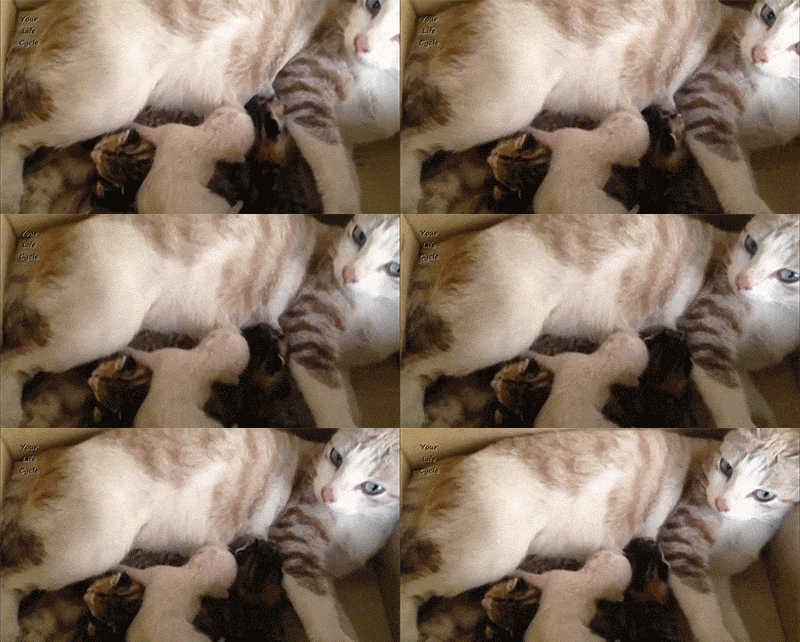
You know, when a kitten is taken from its mother at a young age and lives with you…When it kneads on your lap and purrs contentedly, have you ever had a moment where it felt like your kitten thinks of you as its mother?So, in a kitten’s world, what is the image of their mother?After being separated, do they actually miss her?To answer this question, we first need to understand: can kittens even recognize their own mother?
-
Can Kittens Recognize Their Own Mother?
Let’s start with the conclusion: kittens can distinguish their mother’s voice and retain memories of her scent from before weaning.Mother’s Voice Recognition ExperimentThis research comes from Péter Szenczi and his team at the National Institute of Neurology and Neurosurgery in Mexico.In 2016, researchers, inspired by findings in other mammals (cows, sheep, seals, bats, etc.), wondered whether kittens could also recognize their mother’s voice. They recorded the calls of mother cats as well as calls from other nursing female cats, then played these sounds for kittens and observed their reactions.The results showed that kittens approached the speaker more quickly and meowed more frequently when they heard their own mother’s calls. Researchers concluded that after 4 weeks of age, once a kitten’s ear canals are fully open, it can recognize its mother’s call and respond accordingly.Mother’s Scent Recognition Experiment.In 2021, researchers explored whether kittens can recognize their mother’s scent. They presented kittens with three cotton swabs: one rubbed on their mother, one rubbed on an unfamiliar female cat, and one blank control. They observed how long and attentively the kittens sniffed each swab.At 2 months old, kittens spent more time sniffing the unfamiliar mother’s scent—likely due to curiosity.At 5 months and 1 year, kittens spent the most time sniffing their own mother’s scent.Researchers believe that at 2 months, kittens are so familiar with their mother’s smell that they can immediately recognize it, making unfamiliar scents more interesting. When kittens are separated from their mother for a period and exposed to relatively unfamiliar scents, they pay extra attention to their mother’s scent because it feels familiar.These results indicate that kittens can distinguish their mother’s scent from that of other cats.Conclusion: based on both voice and scent, kittens likely can recognize their biological mother. The next question: do they miss her?
-
Do Kittens Miss Their Mother?
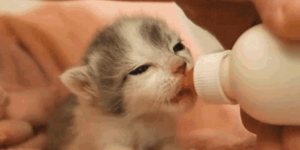
The concept of “missing” in Chinese usually refers to the feelings or attachment one has after being separated from loved ones. But do kittens feel this for their mother?Mildred Moelk observed kittens under different feeding conditions from birth until 8 weeks old to answer this question.Mother-Fed Kittens.From 0–4 weeks, kittens focus entirely on their mother. At this early stage, they have just entered the world, and their primary need is nutrition. Mother’s milk is their only food source.When the mother leaves the nest, kittens without food may meow intensely and frequently. Researchers interpret this as a form of “crying,” intended to make the mother return.So during this period, kittens may miss their mother and hope for her return.From 5–7 weeks, kittens’ attention broadens. They explore more objects and surroundings, playing and practicing hunting skills with siblings. While their motor coordination has improved, researchers found that kittens still remember the mother’s location and may meow if they can’t find her.At 8 weeks, once fully weaned, kittens no longer rely on mother’s milk and start eating solid food. Researchers believe kittens now separate the concept of “mother” from “food.” They respond more to food-related cues than to the mother’s presence, meaning they generally won’t cry if the mother is absent, as long as food is available.Hand-Fed Kittens.Kittens raised entirely by humans without ever meeting their mother were fed and cared for by humans acting as surrogate “mothers.”Researchers placed these kittens alone in a room and provided food, grooming, and litter care at regular intervals for 8 weeks, recording daily growth, activity, and behavior.They observed that when the human caregiver left, kittens also “cried” to signal a desire for food.Conclusion: considering both mother-fed and hand-fed kittens, researchers suggest that kittens may not have a fixed mental image of a “mother.” Instead, whoever provides food and care becomes the object of attachment and dependence.
Kittens raised by their mother may miss her before they are fully weaned, but this is primarily driven by survival needs.So far, no experiment has definitively proven that cats are capable of experiencing true “longing” or nostalgia. After all, their little brains are mostly occupied with eating, playing, and sleeping—there’s hardly any room left for other thoughts!