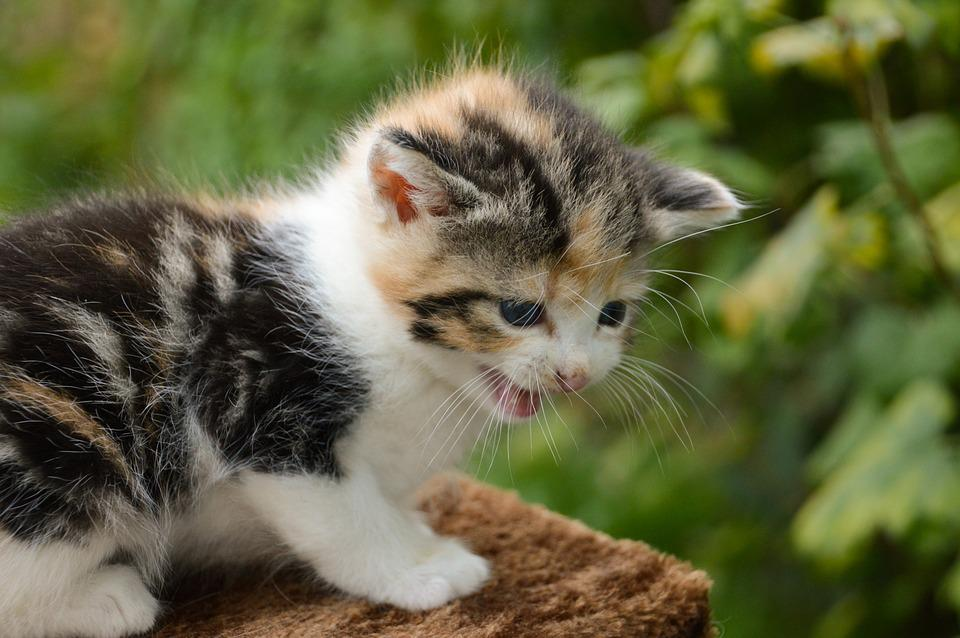
“Why Do Cats Ignore Us When We Call Their Names? Is It Because They Can’t Understand?”When you call your dog’s name or give it commands, your dog often responds with barks or other vocalizations. And when your dog is feeling down, it will whimper to let you know how upset it is—especially that big, dramatic Beagle, which will howl as if it’s about to be turned into a stew, even if you just forgot to give it an extra treat.However, in stark contrast to dogs, cats are much quieter. When you call your cat’s name with affection and eagerness, it often ignores you. But when you notice your cat making its own little “cat noises,” it’s probably because it’s hungry.Do cats dislike communicating with us in “cat language”? Why are cats so silent compared to dogs?
-
It’s Not That They Don’t Understand, They Just Don’t Want to Acknowledge You
In reality, when you call your cat, it’s not that it doesn’t know you’re calling—it’s just that, unlike dogs who respond with sounds, wagging their tails, or other gestures, cats aren’t as inclined to respond vocally. In 2013, researchers at the University of Tokyo conducted a study with 20 domestic cats, adjusting the volume of their owners’ and four strangers’ voices calling the cats’ names to the same level, and played the recordings for the cats. During the experiment, the cats showed the strongest reaction when they were called by their owners for the first time or when their owners called them specifically, signaling recognition by twitching their ears or turning their heads. However, compared to dogs’ eagerness to communicate, a cat’s response is more like a “directional behavior” to see where the litter box attendant (you) is, and as you keep calling, they get more and more uninterested.If your cat doesn’t respond after you call its name multiple times, it’s likely not because it hasn’t heard you—it’s probably just getting annoyed. Cats can be quite ruthless like that. If you find it difficult to communicate with your feline companion, you could try learning “cat language.” As early as 1944, animal behaviorists classified cat vocalizations into 16 different categories, such as purring, meowing, and yowling, and assigned vowels and consonants to each type based on their functions. In 2012, British zoologists, building on previous research, further classified cat vocalizations, adding details about their pitch and duration. This means, theoretically, you can master “cat language” and communicate freely with your cat. If your cat ignores you, you can learn how to speak “cat” and try to communicate with it on its terms—a clever workaround. However, although cats can be a little annoying at times, they’re not as cold as you might think. In fact, part of the feline language system has evolved specifically for human interaction.

-
Sounds Exclusively for the Litter Box Attendant
If silence is a cat’s nature, then domestic cats have developed a more talkative habit just for their not-so-brilliant litter box attendants. In fact, compared to their more aloof wild cousins or even other carnivorous animals, domestic cats actually make more noise. Not only that, but there are also differences in the “accent” between house cats and wild cats. In 2004, researchers at Cornell University recorded 535 meows from 12 domestic cats and analyzed them, discovering that, compared to wildcats, the average duration of domestic cats’ meows was shorter (0.84 seconds vs. 1.50 seconds), their fundamental frequency was higher (609 Hz vs. 255 Hz), and participants found the house cat’s meow to be more pleasant. Wildcat meows are often deep, raspy, and prolonged, while your domestic cat’s meow is crisp and short like a kitten’s.As for why this difference exists, researchers pointed to a hypothesis proposed in the 1990s: the change in domestic cat meows is meant to adapt to human hearing. In 1998, zoologist Eugene Morton proposed the Motivation-Structure Theory of animal vocalizations, which stated that higher pitch sounds are typically associated with smaller, younger, or non-threatening individuals. In other words, house cats have gradually evolved their sounds to make humans feel comfortable and secure. And the more you take care of your cat, the more secure it feels, so the sounds it makes in response to certain stimuli are also softer and less aggressive than those of wildcats.In 2011, a South Korean research team compared 25 wildcats and 13 domestic cats, finding that, in situations with unfamiliar people, wildcats emitted more prolonged and higher-pitched threatening sounds, such as growls and hisses. In contrast, domestic cats’ sounds were softer and less aggressive. This, in fact, is the result of long-term communication and mutual influence between you and your cat.
-
Not Much of a Speaker, But Enough to Get By
Despite their unique language system, cats’ communication skills aren’t the most impressive in the animal kingdom. Dogs, who have been domesticated longer than cats, have communication abilities that are actually quite similar to those of cats. Canadian animal psychologist Stanley Coren divided dog vocalizations into 11 categories, including barking, whining, and more. The reason dogs often appear to understand humans better than cats is that, in addition to their barking, dogs also use their tail movements, eye contact, and even mouth shapes to express a wider range of emotions.The true language experts in the animal world might surprise you: groundhogs. Like many animals, they also use sounds to communicate with their peers. However, unlike other animals, their language has grammar. In 2002, U.S. biologist Slobochikov and his team observed groundhogs in the wild, finding that their vocal system includes elements similar to nouns, verbs, and adjectives, and even has dialects between different populations. For instance, when encountering a predator like a wolf, groundhogs can describe the predator’s color, size, shape, and even its speed using distinct vocalizations.
Although cats aren’t great at talking and can’t describe, with their meows, their desire for a tasty fish treat like other animals might, they’re not social creatures like dogs, nor do they need to survive in the wild like groundhogs. Their 16 vocalizations are, for now, more than enough. Besides, not chatting with their litter box attendants doesn’t really cost them much. After all, in a typical human-cat relationship, it’s usually you who’s chasing after your introverted feline companion, trying to start a conversation, while your cat remains silent, and when it doesn’t respond, you’re the one poking at it.