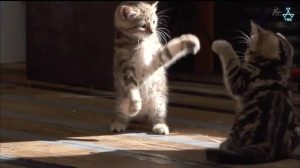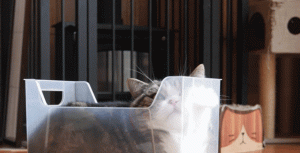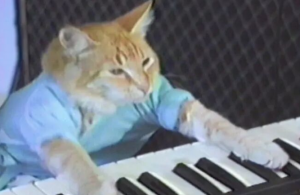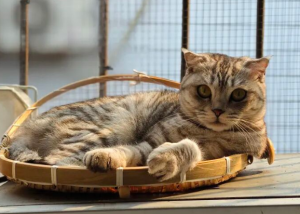
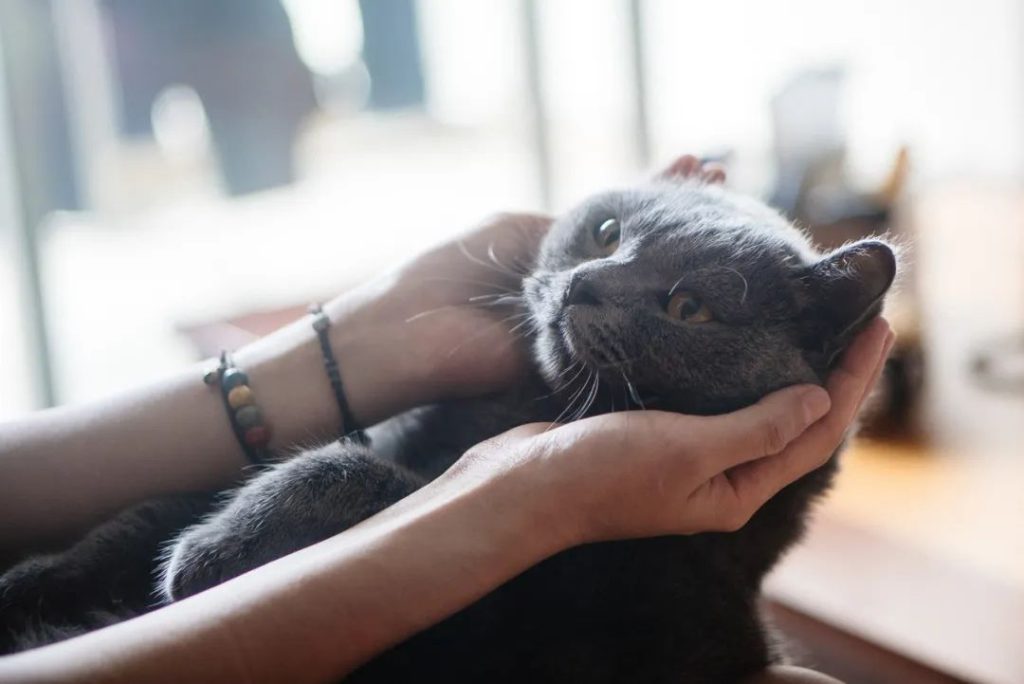
If you’re wondering what can heal a workaholic’s shattered soul, it has to be virtual cat petting. Those tiny, pink paws, the fluffy little heads, and those sweet little expressions… As you immerse yourself in the cuteness of cats, you suddenly realize a question: Do cats really smile because they’re happy?
-
30,000 Years of Evolution, and Cats Have Become Poker-Faced
A sad truth is that cats really don’t have a concept of smiling. As we all know, dogs understand humans. After living alongside us for over 30,000 years, they’ve mastered eye contact and even evolved a new muscle near their eyebrows just to give us those heart-melting, puppy-dog eyes. However, cats are completely different. After killing thousands of fish in the wild over millennia, the hearts of cats have become as cold as the butcher’s knife in a supermarket. As solitary predators, cats have evolved to maintain a poker face to preserve their aloof persona, ensuring their prey doesn’t see hesitation and their enemies don’t detect fear. Studies show that cats only have 15 distinct facial expressions, 6 larger facial movements, and 7 ear movements—far fewer than humans or other primates. In comparison to dogs, they’ve had only one-third as much time with humans—just 10,000 years—which is hardly enough to change their cool nature or evolve new muscles like dogs did under the pressure of survival.
-
Your Cat Isn’t Smiling, It’s Just Sniffing
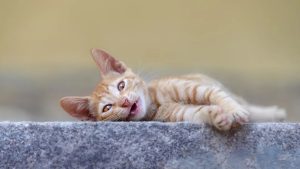
So, here’s the question: If cats don’t smile, what are those little upward-curved expressions? On one hand, cats’ lips are naturally shaped in a “W” form, often referred to as “smile lips,” which easily gives the illusion that they are smiling. Capturing moments when a cat yawns, sneezes, or reacts to stress might make it look like they’re grinning. On the other hand, cats have a “flea lip response”: when they catch a scent they find interesting, cats curl their upper lips to allow the smell to quickly reach the vomeronasal organ in their nose, helping the brain process the scent more efficiently. This behavior involves curling the lips, tilting the head, and squinting—almost identical to a smile. This also explains why cats seem so surprised when they’re near their owner’s smelly feet. It’s not shock; it’s simply that they’re trying to get a better sniff to figure out what on earth that pungent smell is!
-
Cats Don’t Smile, But They Do Get Happy
Although cats may seem poker-faced, they still express happiness with their eyes. When they slowly blink at their owner, it’s a sign they’re fully relaxed. The familiar purring sound is also an indication of contentment. More importantly, even though they appear aloof, cats have quietly come to depend on humans. A study published in Current Biology in September 2019 revealed that cats are actually very attached to their owners. Among 70 kittens in the study, 64.3% were categorized as securely attached. Two months later, this percentage increased to 68.6%. These numbers are almost identical to the 65% attachment ratio found in human babies with their caregivers, and even surpass the 58% attachment in puppies.
Humans may not have taught kittens how to make facial expressions, but we’ve already shown them what love is. Feel free to leave a comment and share some pictures in the comment section—we’d love to exchange cat parenting tips and stories!