
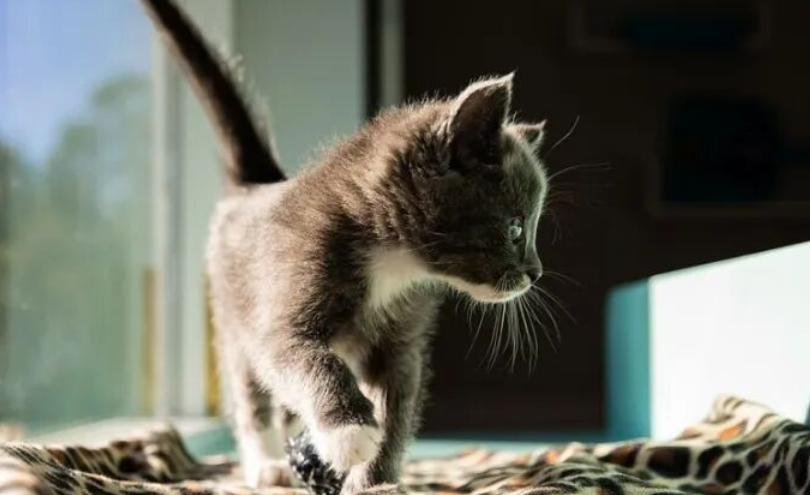
The world as cats perceive it is completely different from ours.If we want to walk in a cat’s paws, the first step is to understand how cats experience their environment.Although cats have the same five senses as humans — sight, hearing, smell, taste, and touch — the way they process and interpret sensory information is vastly different from ours.Still, there are fascinating similarities between feline and human senses. Recognizing these can help us interact more harmoniously with our furry companions.In 2016, Tom Roy and Ruth Roy designated January 2nd as “Meow New Year’s Day”, a special day to celebrate with cats.When you ring in the new year with your feline friend, take the opportunity to learn more about them and strengthen the bond you share.
-
Sight
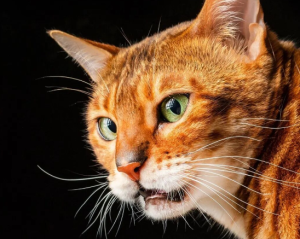
Cats perceive the world very differently from humans.If we wanted to walk in a cat’s paws, the first step is to understand how they see and interpret their surroundings.Although cats have the same five senses as humans — sight, hearing, smell, taste, and touch — the way they process visual information is drastically different.Cats can pounce accurately even in near-total darkness, almost as if they have built-in night vision, but they still need a bit of light. Compared to humans, whose night vision is limited, cats truly shine in the dark. Over millions of years of evolution, many cats have become especially active during dusk and dawn, the ideal times for hunting.Light enters the eye through the cornea, the round, transparent surface at the front of the eye. In cats, the cornea is large and dome-shaped, allowing their eyes to capture the maximum amount of light — a crucial adaptation for low-light conditions.Cats’ pupils are vertical slits, narrowing to a thin line in bright daylight and expanding dramatically in dim conditions. In fact, a cat’s pupils can dilate up to 300 times, whereas humans’ pupils expand only about 14 times.At the back of the eye, cats have a layer called the tapetum lucidum, which reflects unabsorbed light back onto the retina. This adaptation enhances night vision and is also why cats’ eyes glow in the dark when light hits them.Cats also have superior peripheral vision compared to humans. However, their central vision is less sharp. With fewer cone cells — the light receptors responsible for color perception — cats see a more muted, less colorful world. These fewer cones also mean their visual acuity is lower, so although they excel in low light, their vision is blurrier.For example, what a cat can see clearly at 60 centimeters, a human can see clearly from 30 meters away. But this doesn’t affect their agility. Cats are far more attuned to movement than to fine detail or color, so weaker color vision does not hinder their hunting or daily activities.
-
Hearing
Cats’ triangular ears act like small, plush satellite dishes.Their ears can rotate independently forward, backward, and sideways, narrowing the search area for sounds. This rotation can reach 180 degrees, allowing cats to pinpoint a sound from three feet away in just 1/600 of a second — faster than a blink.Cats can also detect minute differences in pitch, even as small as 1/10 of a tone. Their ultrasonic hearing surpasses humans and even dogs, but that doesn’t mean they enjoy human music.In 2015, two U.S. university research teams tested cats with melodies composed specifically for feline hearing, including purrs and pulses simulating nursing sounds. The results showed cats preferred “cat music” such as Cozmo’s Air and Rusty’s Ballad, rather than songs composed for humans.
-
Smell
Unlike the other senses, a kitten’s sense of smell is fully developed at birth.Newborn kittens quickly locate the nearest nipple with their nose to suck the nutrient-rich colostrum and milk.Experts estimate that a cat’s sense of smell is about 13 times stronger than humans’.The olfactory epithelium in a cat’s nose — the specialized tissue for detecting scents — is 5 to 10 times larger than humans’, containing up to 200 million scent-detecting cells, compared to 5 million in humans.Cats also have a secondary tool: the vomeronasal organ, located above the roof of the mouth. Its receptor cells connect to brain regions involved in sex, feeding, and social behavior. When a cat encounters an intriguing scent, it slightly opens its mouth and curls its upper lip — a behavior called the flehmen response. This movement channels air molecules to the vomeronasal organ, giving the cat an enhanced ability to detect chemical signals.
-
Touch
A cat’s whiskers may be one of our favorite features, but for cats, they are essential sensory tools.Whiskers, or vibrissae, are longer and thicker than regular fur. Each whisker grows from a follicle rich in nerves and blood vessels, making them as sensitive as human fingertips.Whiskers compensate for cats’ relatively weaker close-range vision, detecting subtle air currents. This allows cats to track prey movements and navigate around obstacles with remarkable precision.
By now, you have a deeper understanding of how cats perceive the world, and your feline friend probably seems a bit easier to understand as well.