
Yes, cats can be influenced, and they can be influenced even more by humans. Cats have five ways of learning: habituation, sensitization, classical conditioning, operant conditioning, and observational learning.
-
Cats Are Excellent at Observational Learning
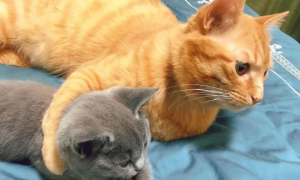
①The easiest way to teach a cat bad (or good) behavior is through their mother. A 2017 study published in Nature found that many of a cat’s early behaviors, like hunting, grooming, and burying waste, are learned by mimicking their mother. Kittens learn these skills by observing their mom’s actions. So, if a cat mother has any bad habits, they are easily passed down to the kittens through both actions and example.②Kittens that live with their mothers are more likely to develop bad (or good) habits. A study from Texas State University discovered that the speed at which cats learn is closely tied to whether they were raised by their mothers or lived with other adult cats. Cats that had spent time with their mother or other adult cats usually have stronger learning and mimicking abilities.③In addition to other cats, humans can also teach cats bad (or good) behavior. A 2020 study published in Science showed that cats can map human body parts onto their own body structure and imitate actions such as clapping hands or opening things. (Currently, only dolphins, parrots, apes, and orcas have been shown to imitate humans.) However, the willingness and ability of cats to mimic humans can vary significantly from one individual to another. Fortunately, besides direct demonstration, we can also use the other four methods to teach our cats bad or good habits.
-
Desensitizing Your Cat through Habituation/Sensitization
Sensitization is when a cat becomes more sensitive after repeated exposure to a stimulus, while habituation is the opposite. For example, a kitten that has never been exposed to loud noises might get scared by a sudden sound, running away or hissing in response. However, with proper guidance, the kitten may learn over time that “this is nothing to worry about” and gradually become accustomed to the noise.
-
Using Classical/Operant Conditioning to Help Your Cat Develop Habits
You can teach your cat a behavior pattern based on the principle of “If I do XX, I’ll get XX as a reward.” For example, many kittens learn that “if I meow and scratch the door early in the morning when the human is still in bed, they will get up and give me food (and I’ll do this again next time)”; or “if I stay quiet, they’ll feed me after they get up.”
So, what type of cat do you have? Feel free to leave a comment or share pictures in the comment section. Let’s exchange tips and stories about cat care together!