
Smart cat owners may have noticed this phenomenon. Some cats have sweet, soft meows, while others are born with a raspy “smoky” voice. There are even some kittens whose meows sound completely different in front of people versus when they’re alone. Why do cats make sounds that seem at odds with their personalities? Is the difference in their meows intentional or accidental? Today, let’s explore the mystery behind a cat’s vocal tone.
-
Why Do Cats Have Different Vocal Tones?
First, we need to understand how cats produce sound. Just like humans, a cat’s voice is created by the vibration of its vocal cords or other throat tissues. The vocal cords are the key to determining the sound quality! Since each cat has vocal cords of different widths, lengths, and thicknesses, the amplitude and frequency of their vibrations vary. Additionally, the shape of their throat also differs, which results in different vocal tones. For example, a large, muscular “tough cat” may have short, thin vocal cords, producing a soft and high-pitched meow. Meanwhile, a sweet-looking cat with long, thick vocal cords might have a deep, gruff voice like an old man. In other words, a cat’s basic vocal tone is innate—some cats may even have a “loli” voice due to nature’s playful design. However…
-
A Cat’s Voice Isn’t Always the Same
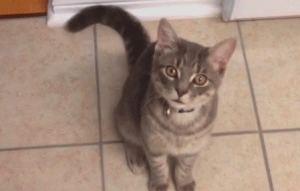
While a cat’s basic vocal tone is fixed, there are cases where their voice changes. For example, the so-called “clipped voice.” Many cat owners notice that their cats meow in a soft, cute voice in front of them, but when they’re alone, they might suddenly belt out a loud, raspy howl. If you only listen to the sound, it’s hard to believe it’s the same cat… Why does a cat change its voice behind your back—is it intentionally being coy? Yes, it’s intentional! According to research in comparative psychology, cats know how to meow to get what they want. Studies have shown that a cat’s vocal choices largely depend on how their owner responds. If a cat finds that certain sounds help them achieve their goals, they will use them again. For example, cats often notice that a soft, slightly whiny voice gets a better response from their owners, so when they want attention, petting, or treats, they’ll use that “clipped voice.” Emotions also play a role in how cats meow. A 2019 study on cat vocalizations recorded and analyzed 780 meows from 40 cats. The results showed that a cat’s vocal tone is influenced by their emotional state. When a cat is in a positive mood (such as anticipating playtime or meeting a favorite person), their meows tend to be higher-pitched, shorter, and end with a rising intonation. In contrast, when they’re feeling negative emotions (like being left alone or anxious), their meows are usually lower-pitched, drawn out, and sound sad. For example, after you leave the house, your cat’s meow may carry an unmistakable sense of disappointment… In addition to emotional changes, there are several physical factors that can affect a cat’s voice: changes in the vocal cords, vocal cord development, and the natural maturation of the voice from kittenhood to adulthood, much like a human’s “voice change” period. Damage or illness to the vocal cords can also lead to sudden changes in a cat’s voice, often linked to throat abnormalities such as upper respiratory infections (which are usually accompanied by sneezing and nasal discharge), pharyngitis (caused by inflammation, excessive meowing, foreign objects stuck in the throat, or chronic coughing), neck injuries (which may affect the vocal cords if the throat area is damaged), or muscle and nerve issues (like laryngeal paralysis, where nerve dysfunction prevents the vocal cords from opening and closing properly). Tumors can also compress the vocal cords and surrounding tissues, causing changes in the voice. If you suspect a health issue, it’s advisable to take your cat to the vet for an examination.
-
Which Voice Changes Should You Pay Attention To?
The first thing to observe is when the voice change happens and whether there were any abnormalities before the change (such as frequent loud meowing). Also, check your cat’s eating, elimination, and overall condition to ensure they are normal. Common situations include:Sudden hoarseness: Make sure your cat has enough water, as this is often self-recovering. However, if coughing or nasal discharge is present, it may indicate an upper respiratory infection or pharyngitis.Older cats with quieter or altered meows: This is a normal sign of aging. As their physical functions decline, it can affect their vocal cords. Some elderly cats may even meow louder due to hearing loss.
In conclusion, as long as the change in vocal tone is not sudden or abnormal, there’s no need to worry. Whether your cat has a sweet, “loli” voice, a deep “uncle” voice, or a smoky, magnetic tone, it doesn’t take away from their unique cuteness!