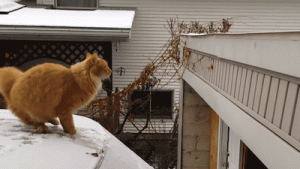
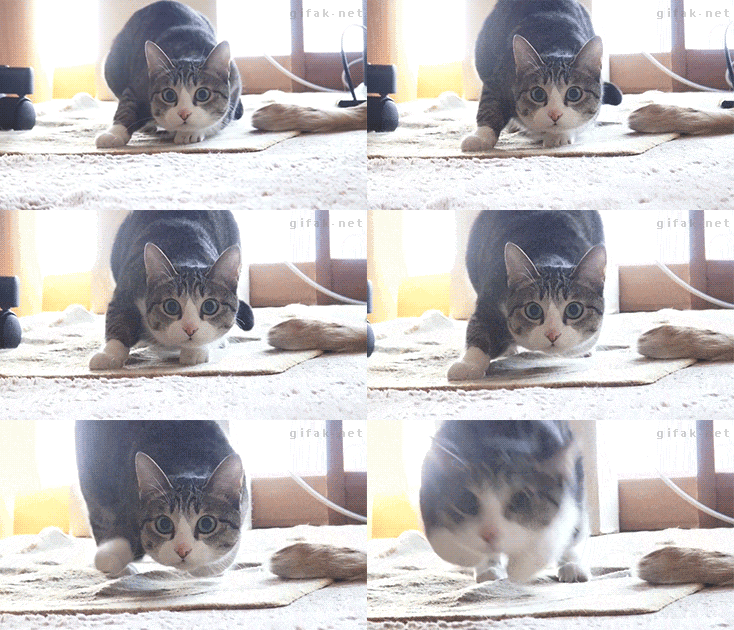
Have you ever interacted with a cat—or noticed a cat staring intensely at something, its head completely still, ears flattened back, and its rear wiggling rapidly like it’s powered by a tiny motor?Why do cats make this movement before launching an attack?What secret lies behind this curious behavior?Today, let’s dive in and find out!
-
Cats Are Storing Up Energy
When cats wiggle their butts, they are actually gathering energy for an upcoming attack.It’s just like a sprinter crouching at the starting line, adjusting their stance and storing energy to launch forward at maximum speed.Every time my cat spots the little fuzzy ball on a teaser wand swaying back and forth and gets ready to pounce, its rear starts wiggling.Its hind legs bend slightly, and as the butt wiggles, the muscles tense, as if concentrating all the strength in its body.Once it feels ready, it shoots forward in a flash—fast as lightning.For a cat, wiggling the butt is like “charging up,” giving it the power needed to strike with maximum force.
-
Finding the Optimal Force and Balance Point
When attacking, a cat needs precise control over its body to ensure agility.This requires finding the perfect point to generate force and maintain balance.Whenever my cat prepares to pounce on the little bell on a scratching post, it first wiggles its butt.The rear shifts left and right, eyes locked tightly on the bell, while the body subtly adjusts.Through this movement, the cat finds the best stance to launch itself, ensuring stability during the jump and strike.It’s as if the cat is silently saying: “I need to get the position just right so I can grab that bell in one move.”
Wiggling the butt helps the cat adjust its center of gravity, making its attack smoother and more precise. -
Locking Onto the Target
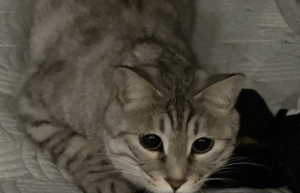
From a hunting instinct perspective, butt-wiggling is also about locking onto the target.In the wild, cats must calculate the position and movement trajectory of prey accurately.A friend’s cat once noticed a tiny flying insect in the house. First, it quietly crouched on the floor, eyes fixed on the bug, then slowly started wiggling its butt.Its gaze never left the insect, and as the rear moved, its focus became even sharper.At this moment, the cat is probably thinking: “Little bug, you can’t escape—I’ve got my eyes on you.”Wiggling the butt allows cats to concentrate, lock onto their target, and prepare for a successful capture.
-
Judging the Attack Distance
Another key reason cats wiggle their butts is to judge the distance to their target.They need to know how far away the prey is to decide how much force to use and at what speed to strike.My neighbor’s cat, whenever it spots a bird perched on a tree branch outside the window, starts wiggling its rear as it prepares to “attack.”While wiggling, it keeps looking back and forth between the bird and itself.This motion helps the cat estimate the distance. If the target is close, it might pounce immediately; if farther away, it adjusts its stance to prepare for a longer leap.For cats, accurately judging attack distance is a critical step toward a successful hunt.
-
Excitement and Dopamine Surge Before the Hunt
This butt-wiggling action also stimulates dopamine, making cats excited and ready for the hunt.Dopamine generates pleasure and excitement, boosting their drive during an attack.A colleague’s cat, whenever it sees a catnip ball, first circles around it a few times and then starts wiggling its rear energetically.Its eyes sparkle with excitement, and soon the cat is full of energy, launching an “attack” on the catnip ball.For cats, butt-wiggling is like flipping a switch, opening the “valve” of excitement and fully preparing them for the upcoming hunting moment.
This is a behavior unique to felines—pretty fascinating, right?Have you ever seen a cat wiggling its rear like that?What do you think it’s doing?