Why do animals have whiskers? Many people, as children, have probably heard the story that “cats use their whiskers to measure the size of mouse holes.” However, upon closer inspection, this explanation is quite limited—cats and other felines rely on ambush and quick pouncing to catch their prey, not on squeezing through holes. In reality, whiskers are a fascinating and complex sensory organ, and countless studies and discoveries have been made about them. The exploration of whiskers should not be confined to a simple childhood story.
-
This Whisker is Not That Whisker
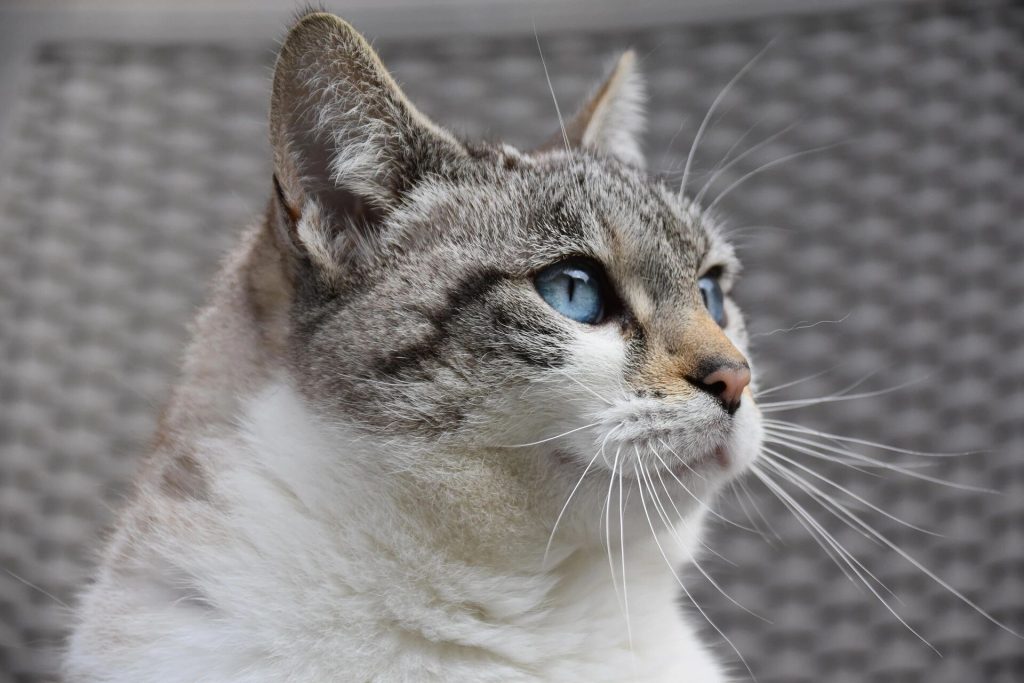
For humans, whiskers refer to facial hair found on men. However, the “whiskers” we’re talking about here are a special type of sensory hair found around the mouth, face, above the eyes, and on the forelimbs of mammals. These whiskers are known as vibrissae in English. Cats’ and mice’s whiskers are classic examples of vibrissae. To avoid mixing languages, we’ll refer to vibrissae as “tactile whiskers” from here on. The majority of mammals have tactile whiskers, with only two groups completely lacking them: monotremes (egg-laying mammals like the platypus) and the great apes, including humans (no, we won’t consider humans here). Tactile whiskers are longer and thicker than regular hair, with large hair follicles surrounded by a network of sensory nerves, which originate from the trigeminal nerve’s infraorbital branch. Though hair is essentially dead, the pressure exerted on it transmits to the mechanoreceptors in the follicle. This information is collected by both deep and shallow tactile whisker nerves and sent to the brain. Some animals with particularly sensitive whiskers, such as mice, the Eugene kangaroo rat, and the California sea lion, have brain regions specifically responsible for processing whisker sensory data.
-
Pathfinding and Object Recognition
The primary function of tactile whiskers is to act as “pathfinding sticks” in dark or complex environments. Small mammals like mice have highly flexible whiskers that can move in all directions to gather information. Before moving, mice lower their heads to increase whisker contact with the ground. As they walk, their whiskers swing from side to side, keeping their front paws within the area swept by the whiskers. While running, they point their whiskers forward to avoid collisions. In addition to pathfinding, tactile whiskers are also used to identify prey. The European mole, which has poor vision and hunts at night, relies heavily on its whiskers for prey detection. With its sensitive whiskers, the mole can accurately target the nerve-rich area of a cricket’s thorax, paralyzing it. The European mole is the smallest mammal, weighing only 1–3 grams, and crickets are nearly the same size. Crickets defend themselves with their spiked hind legs, making it essential for the mole to target the cricket’s vital areas. Interestingly, the mole can also attack plastic models of crickets, suggesting that it uses its whiskers to identify the overall shape of objects, much like humans use vision.

-
Do They Have Whiskers, Too?
Another group of whisker-using hunters includes larger animals. The whiskers of seals can sense water disturbances. Seal whiskers are flat and have a wave-like contour—this isn’t a natural curl, but rather a regular pattern of varying thickness that helps reduce vortex turbulence around the whiskers, acting as a “noise-canceling” effect. Seal whiskers are extremely sensitive and can detect tiny water currents of 245 micrometers per second (0.88 meters per hour), allowing them to sense the tail stream of herring swimming 180 meters away. There are reports of blind but otherwise healthy wild seals, indicating the extraordinary sensitivity of their whiskers. The most unusual whisker user is arguably the animal least expected to have “whiskers”—the whale. While most whales have completely degenerated hair follicles, the Guiana dolphin has transformed its remaining whisker follicles into a novel sensory tool: an electroreceptive device. The whisker follicles on the dolphin’s upper jaw are flask-shaped, surrounded by capillaries and a developed trigeminal nerve branch, with the follicles filled with a gel-like substance. This device is highly sensitive to weak electrical currents, a feature shared with the platypus and some cartilaginous fish. Experiments show that the Guiana dolphin can respond to a voltage as low as 4.6 microvolts, more sensitive than the platypus (which responds to 40–50 microvolts), but less sensitive than cartilaginous fish. The Guiana dolphin lives in murky, low-visibility waters and feeds in the seabed mud, and this electroreceptive system helps it detect weak bioelectric signals emitted by fish (not electric fish).
-
Secrets Hidden in Whiskers
Though humans don’t have tactile whiskers, they are of particular value to scientists. The arrangement of whiskers is as unique as fingerprints, with each animal’s pattern differing. In-depth studies of animals often require individual identification. For example, if you want to know how many lions are in a specific area, you must be able to recognize each individual lion; otherwise, you might mistake one lion for ten or vice versa. Therefore, zoologists need to identify unique and easily recognizable traits—tactile whiskers provide just such a clue. Zoologists have successfully used whiskers to identify individual lions, sea lions, and polar bears. Tactile whiskers grow continuously, with the whiskers of a serval lasting around 100 days on the face, and a weasel’s whiskers lasting up to 5 months. Moreover, whisker composition is stable and easy to sample. This makes tactile whiskers useful as “face diaries,” offering insights into an animal’s life. The composition of whiskers can also tell us what the animal has eaten. Some plants cultivated by humans, such as corn and sugarcane, are rich in carbon-13 isotopes (which have one extra neutron compared to regular carbon atoms). Therefore, animals that eat “human food,” such as mice, and those that eat mice, like servals, will also have higher levels of carbon-13. By analyzing the carbon-13 content in whiskers, we can assess how much an animal’s diet depends on human food. Hormones accumulated in hair can also provide valuable information about an animal’s life history. For example, pregnant animals have higher progesterone levels, and animals under stress have elevated cortisol, which can remain in the whiskers, providing a “personal history” of the animal. However, because whisker growth doesn’t follow a strict annual cycle like tree rings, interpreting this “diary” requires some skill. Scientists have designed experiments where they fed lions and leopards in zoos giraffe meat for a period and then checked the carbon-13 levels in their whiskers. Zoo animals are usually fed beef and chicken, which are high in carbon-13, while giraffes have very low levels. By identifying sections of whiskers with low carbon-13 content and cross-referencing with the time they were fed giraffe meat, researchers can estimate whisker growth rates and the time it takes for elements from food to enter the whiskers.
Research on tactile whiskers has a history of over a century, yet in many ways, it remains an unexplored frontier. The whiskers don’t just reach into mouse holes—they extend into the mysteries of countless mammalian secrets.