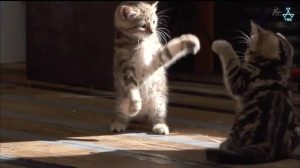

It is often said that “cats have nine lives,” but when cats get older, become ill, or experience accidents, they too can meet their demise. While the idea of “nine lives” is just a myth, it does highlight the incredible resilience of cats. We often see cats climbing tall trees or walking along narrow, high walls, leading us to wonder: Do cats not have a fear of heights? And if they fall, can they survive?The surprising truth is that cats can often land on their feet when they fall from high places, a phenomenon that helps them avoid serious injury (of course, there are limits to this). Scientifically, this ability can be explained by the physical law of conservation of angular momentum!
-
Why Do Cats Land on Their Feet?
The fascinating phenomenon where cats always land on their feet after falling from a high place has drawn attention for decades. In the 1990s, French scientist Marey invented high-speed cameras to record the process of a cat falling from a height. As shown in the images, when a cat falls, it can perform a free spin in mid-air. Its front legs tend to shorten and pull towards the neck, while the back legs extend vertically to the body. This allows the cat to rotate 180°, eventually landing on its feet.The reason cats can land on their feet is due to the conservation of angular momentum in physics. Angular momentum is a measure of rotational motion. In linear motion, we use momentum to describe the state of an object; in rotational motion, we use angular momentum. The magnitude of angular momentum is directly related to the radius and speed of rotation.The law of angular momentum conservation states that in a system, when an object rotates without external forces acting on it, its total angular momentum remains constant. A common example is figure skaters: when they pull their arms in during a spin, their rotation speed increases, and when they extend their arms, it slows down. However, the total angular momentum remains unchanged.Now, let’s look at how this applies to cats. When a cat falls, its rotational direction and speed remain consistent, meaning once the cat begins rotating during the fall, it continues to rotate in the same direction until an external force acts on it.Because the cat’s front and back legs take different positions during the fall, the rotation can be broken down into two parts: the front half of the body and the back half. Scientists refer to this behavior as a “twisting corkscrew” motion, where the front and back halves rotate in opposite directions. When a cat falls, its front legs contract, reducing the radius of rotation. As a result, the front half rotates faster, leading to quicker spinning. Meanwhile, the back legs extend, increasing the radius of rotation, so it rotates more slowly.Eventually, if the front half rotates clockwise, the back half rotates counterclockwise. The total angular momentum from both parts will remain constant, maintaining overall conservation of angular momentum. The cat can adjust its rotation through twisting motions of the waist and spine, changing the moment of inertia of the front and back halves. For example, when the cat bends its front half, its moment of inertia decreases, causing it to rotate faster. Conversely, when the back half is bent, its moment of inertia increases, slowing the rotation.When the front half reaches the correct position, the cat quickly stabilizes its body to stop the rotation. The same process occurs for the back half. Thanks to the cooperation of the front and back halves, the cat’s entire body adjusts to land in the right position. Of course, this is further aided by the cat’s remarkable jumping ability. Cats’ leg joints are flexible, and when they are near the ground, they can use their strong legs to cushion the impact and reduce the force of landing.Additionally, a cat’s body structure and rapid reflexes also contribute to its ability to land safely. Cats have extremely flexible bodies, with five more vertebrae in their spine than humans, which allows them to rotate their bodies in mid-air and adjust their falling posture. Their reflexes are highly developed, enabling them to sense their position and quickly flip their body during the fall using a reset reflex. All of this ensures that the cat lands safely.Now, if you don’t fully understand the physics behind this, don’t worry! As long as we know that cats are truly amazing, super amazing, and incredibly amazing, that’s enough… But let’s explore a few more of their special skills, which are easier to understand.

-
What Other Special Skills Do Cats Have?
Superb Hearing.One of the best-known skills of cats is their ability to catch mice. This skill is closely tied to their extraordinary hearing. Cats have five times more muscles in their ears than humans, and their ear structure is much more complex. Cats can hear a wider range of sound frequencies than humans—three times that of humans—enabling them to detect ultrasonic and infrasonic waves that humans cannot hear. Their ability to accurately pinpoint sounds, even from far away, is what makes them such proficient hunters. No matter how far away a mouse is, a cat can track it down with precision.Exceptional Night Vision.At night, we often notice that cats’ eyes appear large and bright. Due to the structure of their eyes, cats possess exceptional night vision. The light receptors in their eyes, primarily composed of cone cells and rod cells, play a crucial role in their ability to see. Cone cells determine vision in bright light, while rod cells are responsible for vision in low light conditions. Cats have more rod cells than humans—about six times more—which gives them superior night vision capabilities.
You might be surprised to learn that cats have so many special skills! By the way, a healthy adult domestic cat can run at speeds of over 40 km/h in a short sprint, which means they could race alongside the fastest sprinter, Usain Bolt! While cats are incredibly agile, never throw a cat from a height just for the sake of an experiment—they can still get injured or even die.Also, if you want to test their reaction, try gently holding a cat belly-up on a soft surface like a sofa or mattress, and then release it from a low height. The cat will likely end up in a funny, sprawled-out position. This happens because the fall is too short for the cat to react in time!