We often see news stories about police dogs successfully sniffing out drugs or tracking down criminals. So, why aren’t cats chosen to be police animals? Is it because people look down on our little cats? Today, let’s dive into why we have police dogs but no police cats.
-
Cats Have Some Natural Talents for Being Police Cats
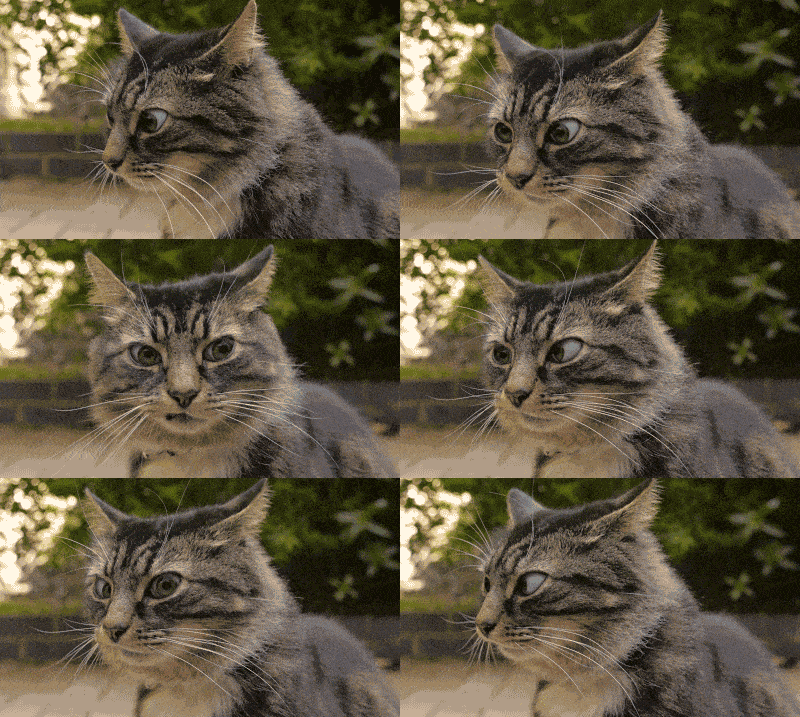
Actually, cats have quite a few talents that could make them great police animals, and in some areas, they’re even better than dogs. For example, their exceptional sense of smell. We usually judge the strength of an animal’s sense of smell based on how well they detect faint odors and differentiate between various scents. In terms of detecting weak smells, researchers generally believe a cat’s sense of smell is 10 to 14 times stronger than that of humans. When it comes to distinguishing between different smells, cats outperform both dogs and humans. This is because cats have more than three times the number of specific receptors (V1Rs) in their vomeronasal organ compared to dogs, and humans’ vomeronasal organs have greatly regressed.Cats also have remarkable hearing. Their hearing range is broader than both humans and dogs, allowing them to hear more sounds. Additionally, cats have 32 muscles around their ears, which can rotate 180 degrees, allowing them to gather more sound waves and expand their hearing range. Dogs have 18 muscles around their ears, also capable of rotating 180 degrees, while humans have almost no ear muscle movement. Cats also have excellent sound localization skills, able to distinguish two sound sources that are 15–20 meters away and just 1 meter apart. The small notch in their ears (called Henry’s pocket) is believed to help amplify sound.As for their physical agility, cats have more bones than humans, and their unique skeletal structure allows them to be incredibly flexible, almost like liquid. They can squeeze into tight spaces and corners, making them excellent at exploration and search tasks. Cats are excellent jumpers, capable of leaping 5 to 6 times their body length in height or distance. They are also great climbers, able to scale high places to observe their surroundings. Their silent paw pads and quick movements make it hard for them to reveal their location.
-
So, Why Are There No Police Cats?
Given how capable cats are, why aren’t they selected and trained like dogs to become police animals? The main reason is that cats are much less obedient! Most cat owners will agree with this. Cats are incredibly independent creatures, and even today, they remain semi-domesticated. In their minds, survival doesn’t rely heavily on humans, so they’re less interested in following commands. Only a few cats with strong desires (such as a love of food) may learn simple commands like shaking paws or sitting after repeated training. But for a cat to become a police animal, high obedience is essential!Another issue is their overwhelming curiosity, which often leads to distracted attention. The moment they hear a sound, they’ll perk up their ears, look around, or rush over to investigate. Their strong curiosity can make it difficult for them to focus during training, and when they’re on a mission, they’re often distracted by something else.Furthermore, when there’s danger, cats are known to flee faster than anyone else. Cats are naturally cautious and shy, and they’re excellent at detecting and avoiding danger. As police animals, they’d have to face strangers, unfamiliar environments, and potential threats. But due to their instinct to protect themselves, a cat might just be gone before anyone even notices.Cats also sleep a lot—around 14–16 hours a day, and up to 20 hours on rainy days. After factoring in time for eating, using the litter box, and grooming, their available working hours are limited.Lastly, the intimidating presence that police dogs have is also a key factor in their selection. Imagine facing off against an intruder:Dog: Woof! Woof! Woof!Cat: Meow~ Meow~ Meow~
-
Rare Police Cats
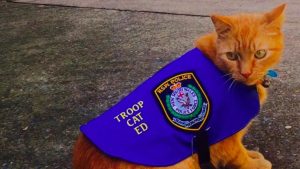
Although there’s no large-scale selection of cats for police work, there are a few rare instances of cats serving in police departments around the world. Unlike police dogs, who go out to fight crime, these cats mostly serve as mascots and mouse catchers.In Lavaca Port, Texas, the local police department adopted a 2-year-old orange-and-white cat as their “police cat.” Named Captain, this cat primarily poses for photos, helps maintain the department’s public image, and offers stress relief to officers by kneading their shoulders.In New South Wales, Australia, the Cavalry Regiment’s stables had a major mouse problem. To solve this, they brought in an orange cat named Ed, adopted from a military friend. Ed patrols the stables daily, effectively keeping the mouse population in check.In Chengdu, China, the Qingyang District Huangwa Street Police Station has its own police cat, Vasily, who spent a year solving the station’s rodent problem. Once the mice were gone, Vasily began wandering around the offices, helping relieve stress and even accompanying officers during night shifts. Occasionally, Vasily would visit the mediation room to help ease tensions, as well as greet visitors.
Although cats may not be out there fighting crime like dogs, they’re certainly doing a great job in positions that suit them! What kind of job could your cat apply for?