
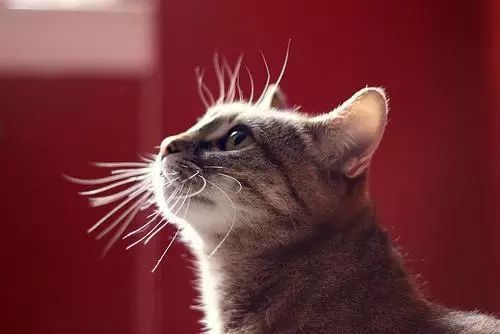
Today, let’s spill some fun secrets about our feline friends’ whiskers~Don’t underestimate them—those whiskers aren’t just for looking cute. They’re packed with amazing superpowers!Let’s take a look together and see how many of these cat-whisker secrets you already know~A cat’s little whiskers—what are they really for…?On Halloween night, when you dress up as Catwoman and draw those whisker lines on your cheeks, have you ever thought about this? The whiskers you copy just for the look are actually one of the essential survival tools for real cats!For true feline explorers, whiskers are their built-in navigation sensors, their emotional indicators, and a tool they absolutely rely on every single day. Whiskers are how they explore the world—and no kitty can live without them!
-
Whiskers Are Extremely Sensitive
Compared with regular fur, a cat’s whiskers are rooted much deeper in the skin, surrounded by dense nerves and blood vessels. All of this makes whiskers incredibly sensitive—so sensitive that they can pick up tiny changes in air movement.This is why even when cat owners accidentally touch or fiddle with their whiskers, it can cause discomfort or even pain.And this is also why narrow, high-rim dry food bowls are absolutely hated by many cats—pressing their whiskers against the sides while eating is super annoying for them!
-
Whiskers Aren’t Only on the Face~
Besides the 8–12 whiskers on each side of the nose, most cats also have small whiskers near their eyes, on their cheeks, and even on the lower part of their front legs.
-
“Can I Fit Through This?” Whiskers Decide!
The whiskers near a cat’s nose are about as wide as the cat’s body. This is crucial for them. If an opening is narrower than their whisker span, the cat will basically think:“If you want me to get stuck… sure, let me try.”Some people say that when a cat gets fat, their whiskers grow longer too. Hmm… any cat parent willing to sacrifice their chubby baby to confirm this theory?
-
Whiskers Are Also Hunting Tools!
Cats are textbook farsighted animals—nothing escapes their eyes from far away. But when a prey item gets close?They can barely see anything.That’s when whiskers step in, giving them precise information about the prey’s size, shape, and movement.Without whiskers, a cat might not even know whether it’s biting a real mouse or just a toy~~

-
Want to Know If Your Cat Is Happy? Check the Whiskers
Not sure how your little master feels today? Just look at the whiskers!If the whiskers are relaxed and spread naturally to the sides, your cat is calm and content.If the whiskers point forward, your cat is excited—probably spotting prey outside the window or getting ready to pounce.If the whiskers are pulled tightly back against the cheeks… cat parents, please step away. Your feline overlord is scared or even angry, and any accidents are not your cat’s responsibility.Of course, reading their body language together with the whiskers will give you the clearest answer.
-
Never, Ever, EVER Trim a Cat’s Whiskers!
It’s natural for whiskers to fall out on their own, but you must never ever ever trim or cut a cat’s whiskers!!!A cat with trimmed whiskers will lose its sense of spatial awareness and may act dizzy or disoriented—because their built-in navigation system (those whiskers!) has been cut.Imagine someone covering your eyes and telling you to live like that for several weeks. How could you not get lost or feel confused?
-
Whiskers Can Change Color
Not like a chameleon that changes color at will, of course—but whiskers can naturally change as a cat ages.A black cat with white whiskers? Totally possible!As cats get older, their fur gradually starts to gray, though it’s usually not very noticeable.
In the end, when you think about it…a cat’s whiskers perfectly hide one simple truth—their faces are actually kind of big.