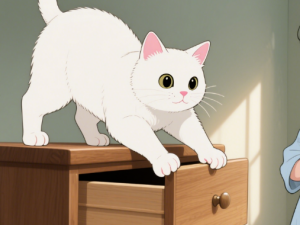
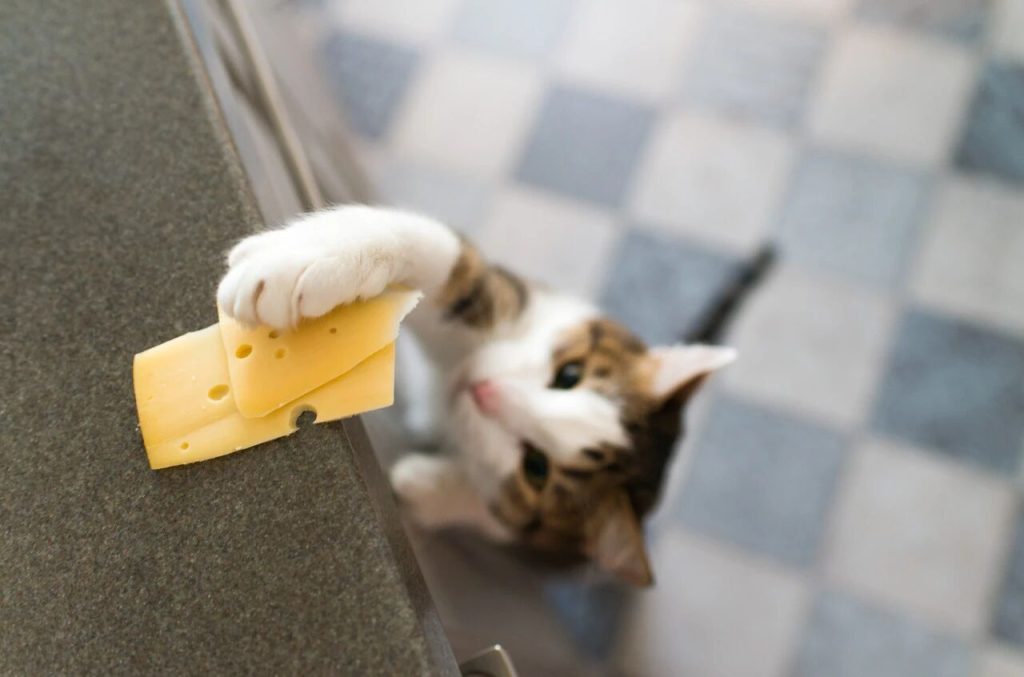
On a relaxing evening with the soft patter of rain on the glass window, you’re wrapped in a blanket, snacks ready, a large cup of cola in hand, and the movie you’ve been saving for ages begins to play. But just as the title appears on the screen, your cat leaps onto the coffee table, blinking its big innocent eyes, staring at your face, and letting out a soft “Meow~.” It’s a call for attention, a command for play. Exhausted, you nervously choose the movie over the cat. Then, in a moment of disappointment, your “evil, sugar-free, fluffy white bun” of a cat elegantly raises a paw—smack—and the ceramic cup filled with cola crashes to the floor. The innocent victim in this battle between you and your cat. This, by the way, is the third time this week that something has been knocked off the table right in front of you. Whether it’s a carefully chosen figurine, a game controller treated as a treasured possession, or the expensive face cream you worked hard to get, the “Desktop Cleanup Master” treats them all the same. Calmly staring at you, the paw continues to prod and push. Looking at the mess on the floor, your blood pressure rises, and you can’t help but wonder: Is your cat’s constant pawing and knocking things off the table intentional, or just a careless accident?
-
The “Crime” Tools: An Essential Paw for Every Mischievous Cat
Every cat that frequently “commits crimes” has a trusty assistant: its paw pads. The cautious approach of testing things with repeated, small movements, paired with the precise, deadly accuracy of a cat’s paw strike, is something every cat owner has witnessed—a stealthy paw sneaking around your beloved belongings. This is simply how cats explore and experience the world. As natural-born hunters, stealth and strategy are key traits. With paw pads full of nerve endings, cats can feel the textures of various objects. The radial nerve controls the top side of a cat’s front paws, while the median and ulnar nerves govern the palms. These nerves are further refined to protect the cat’s curious nature. If this important sensory tool gets damaged, it can significantly affect the cat’s daily life. A study published in Experimental Biology analyzed the kinematic data of four adult female cats walking on a treadmill, showing that when one paw pad was anesthetized, the cat’s center of gravity shifted toward the anesthetized side. So when your cat is batting at fish, chasing butterflies, or knocking over your water cup, it’s experiencing the world in its own feline way. Moreover, whether elegantly strutting towards you unnoticed, or jumping off the coffee table to escape the “crime scene,” the paw pads—designed with three layers of structure—offer both comfort and precision, ensuring that even when the cat “high-tails it” or “low-crawls,” it can do so with ease and grace. Cats, with their perfect design, embody both cuteness and mischief, even in their little acts of causing frustration.
-
It’s Just Part of Becoming a Great Hunter
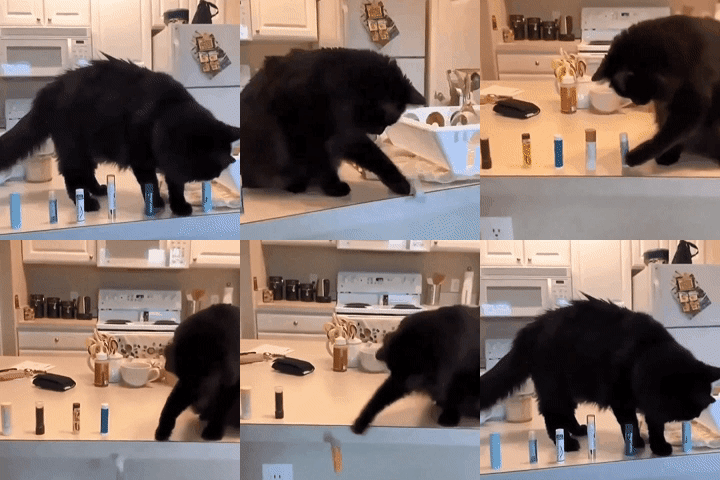
With their tails held high, cats patrol every corner of the house, touching here and sniffing there. This exploratory behavior, which begins in kittenhood, doesn’t fade even when they grow up. For cats, playing is never just a leisure activity—it’s a manifestation of curiosity and a vital part of developing the reflexes and sharpness required to be a great hunter. Kittens often use one paw to gently touch objects (poke/tap), sometimes grabbing and releasing (grip), or excitedly lifting objects to examine them closely (scoop). These actions are repeated, which is why cats spend much more time playing than other carnivores. The poke/tap mode, which makes objects move and triggers a chase, is a crucial step in their play. Researchers have found that 35% of play sessions begin with a poke/tap, often followed by the same action again, with repetitions reaching up to 11 times in recorded sessions. If the object falls during this poke/tap process, you might notice that your cat becomes even more excited. This behavior stems from their unique visual system. Cats perceive slow-moving objects poorly—humans can see things moving ten times slower than cats do. However, cats’ visual processing is highly adapted to quickly moving objects, making them “professionals” at tracking fast-moving prey. So, when your cat knocks your ornament off the table, what they’re really doing is triggering their instinct to chase fast-moving objects. What you see as a “mischievous pawing” might just be the cat’s natural hunting instinct in action.
-
“Indoor Cats Are Just Bored”
In the vast outdoors, cats encounter endless new things to explore. However, for indoor cats who rarely leave the house, their play options become more limited. After controlling for similar feeding and care conditions, French researchers compared the activity patterns of indoor and outdoor cats over a 21-day period. The results showed that outdoor cats walked much greater distances and had higher activity frequencies, with more exploration at night. In contrast, indoor cats had more intense activity “peaks” throughout the day, indicating greater fluctuations between rest and activity. For indoor cats, boredom quickly sets in, and they seize any opportunity to play. Researchers observed indoor cats’ reactions to toys, balls, and sound tests, finding that they showed a heightened interest in most stimuli. With limited opportunities, these cats take whatever they can get, operating on the principle of “a playtime is a good time.” When cats are left alone at home for several hours, lacking interaction and stimulation, they quickly become bored. The solution is simple—they’ll target your valuables. Whether it’s knocking over the TV, scratching the sofa, or knocking your limited-edition Lego set off the table when you come home, it’s not uncommon. For cats, knocking things off is a mental stimulation that helps relieve the monotony of indoor life.
-
If Your Cat’s Mischievous Pawing Is Annoying, It Might Be Your Fault
Life for indoor cats is already restricted, and after waiting all day for your return, if you still ignore them, they’ve got ways to get your attention. Researchers from the University of Adelaide, using cat quality-of-life scales, cat-owner relationship scales, and play behavior scales, collected 1,591 surveys from 55 countries. The results showed that providing cats with a greater variety of toys and games can help reduce boredom and improve overall quality of life. Happier cats have better relationships with their owners. Conversely, if you return home, throw your socks off, and collapse onto your phone without paying attention to your cat, they’ll start seeking attention in other ways: meowing constantly or engaging in destructive behavior. Some cats even withdraw and become more antisocial. Either way, it shows your cat is in an emotionally negative state. So, if they happen to knock over a cup, and you rush to catch it, they might think: “Aha! I found a way to get attention, I’ll try this again.”
So, the next time your cat genuinely invites you to play, whether it’s with a movie or your phone, put them aside for a moment. Otherwise, when you come home next time, it might not just be your limited-edition Lego set in pieces waiting for you.