A True Story.Last month, my mom was taking a stroll downstairs in the neighborhood. When she came back, she looked all mysterious and said to me, “That yellow cat rubbed against my legs again. Do you think it remembers when I used to feed it?” I looked down at her pants, and they were covered in cat fur. I laughed, “With that ‘garlic chive pie’ scent of your coat, how could the cat not remember?”But joking aside, that cat really does have a good memory. Last winter, my mom would go out every day with two sausages in her bag. She’d squat by the flower bed, chatting with the cat like it was an old friend: “Why aren’t you eating again? Your little belly is all flat!” Then, as the weather warmed up, the cat suddenly disappeared. We thought we’d never see it again. But sure enough, after a whole spring passed, it showed up again—first thing, it ran straight over to rub against my mom’s legs.Now, what do you think it was doing? Was it just saying “hello”?No, it was “testing” her.Cats don’t communicate with words, but they speak through their actions. Every seemingly casual gesture actually carries a hidden meaning. Today, I want to talk about three of the most common “testing gestures” cats make. Don’t dismiss it—they’re really asking you quietly, “Are you worthy of me getting close to you?”
-
When a Cat “Rubs Against You,” It’s Not Just Being Affectionate
You might not believe this, but when a cat rubs against you, it often has a purpose. I used to have a roommate who was kind of gruff. When she first moved in, the cat didn’t know her, so it ignored her completely. One day, I was in the kitchen cooking when I suddenly heard her yell, “It rubbed against me!!” I rushed out to see the cat, who was lounging on the couch with a face that said, “Nothing happened.” Later, I asked her what she had been doing. She told me that she had just returned home, holding a grocery bag with some fish inside. Got it? That rub wasn’t affection—it was a “test.” “You have something I want. Let me rub up against you and see how you react.” If you pulled away, it would know you weren’t welcome; if you petted it, it might come back next time. It’s just like a kid testing your boundaries, inching forward to see what it can get away with. To put it bluntly, it wasn’t being affectionate; it was like sending out an “emotional scout” to check you out—rub, and wait for your response. If you’re gentle, it feels safe; if you’re harsh, it will walk away. So, you see, it’s not that the cat doesn’t want to get close—it just hasn’t found someone it feels relaxed with yet.
-
When a Cat “Stares at You,” It’s Actually a Big Test
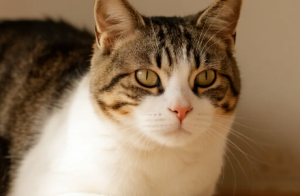
Sometimes, after a long day at work, I drag my tired body home and, as soon as I look up, there’s my cat, sitting on the shoe rack, staring at me. It’s not the usual sad, pleading look—it’s more like, “How are you feeling today? Can I get close to you?”Speaking of which, I suddenly remember this one day when I was completely yelled at at work, and came home with a dark mood. My cat, being no fool, initially tried to approach me, but the moment I sighed, it jumped up to the windowsill, curled its tail, and turned away, refusing to look at me. That night, I couldn’t sleep, tossing and turning in bed, and all I could think about was that look it gave me. It reminded me of that saying: “Cats can sense your energy.” You might think it’s just quietly staring at you, but really, it’s decoding—are you emotionally stable today? Are you trustworthy? Don’t underestimate those few seconds of staring. It’s the cat’s most direct, primal “psychological projection.” Unlike humans, cats don’t wear masks—they don’t throw out polite words. If a cat squints and blinks at you, it means “I trust you.” But if its eyes are wide open and whiskers forward, it’s probably saying, “You’re like a ticking time bomb today. I’ll keep my distance.” So stop calling them “cold”—they’re actually more sensitive than anyone.
-
When a Cat “Jumps on Your Lap,” It’s Trust, Not Just Affection
Do you know how hard it is for a cat to jump onto your lap? The year I adopted Orange, it sat in the corner of the house for nine days. Other than eating and using the litter box, it never even looked at me. On the tenth night, I was curled up on the sofa scrolling on my phone when I suddenly felt a weight on my knees. I looked down, and there it was, sitting on my lap like a traveler who had just decided to stop by, still holding its “luggage.” I didn’t dare move, thinking, “Is this a test of my reaction?” Sure enough, it sat there for about ten seconds, then stood up and walked a few steps, before settling down, wrapping its tail to the side, and closing its eyes. In that moment, I felt a warmth in my heart. It’s a cat, not a dog—it doesn’t rely on people. So, when it jumped on my lap, it was saying, “I don’t want to stand anymore; will you catch me?” This isn’t just affection—it’s a “defense down” moment. Think about it: normally, it’s high and mighty, elusive, and aloof. So why would it suddenly jump onto your lap? It hasn’t changed; it’s just decided, “I’ll try you and see if you’re worth me letting my guard down.” If you stay still and even cover it with a blanket, you’ve won it over. But if you push it away or complain about the fur, it might not come near you for another six months.
To Put It Simply, It’s Not That the Cat Doesn’t Like You, It’s That You Haven’t Passed the “Test”.Cats are intelligent, self-controlled, and have a lot of pride. They won’t ask you directly, “Do you love me?” Instead, they make a few subtle moves, quietly watching your reactions, and then score you in their minds. If you show patience, gentleness, and emotional stability, they’ll slowly inch closer to you.If they try a few times and you keep giving them the cold shoulder, they’ll stop putting in the effort. To put it bluntly, when a cat does these three things—rubs against you, stares at you, or jumps on your lap—it’s like asking a question: “Can I trust you with myself?” If you respond the right way, they’ll stay; if you don’t, they’ll back off. There’s no drama, no revenge—just quiet distance.