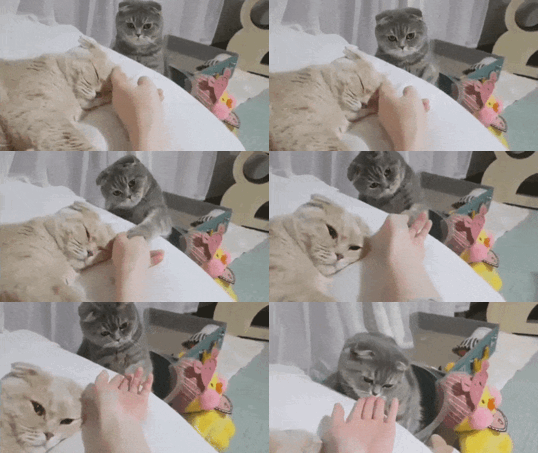
Cats are often described as animals that look down on you regardless of whether you’re in good times or bad. By this logic, kittens should be indifferent to humans. But wait! Many people have noticed that cats might actually get jealous when they feel ignored or when there’s preferential treatment. For example, they might lash out at other cats that their human is hugging — or even at dogs. They might even show jealousy toward human babies. Some cats even express their frustration by hissing at newcomers, giving the cold shoulder, or, in some extreme cases, going on a hunger strike. Does this mean that cats aren’t as cold and indifferent as humans often think? Could it be that they care about how we share our love with other creatures? Thinking about it this way suddenly makes you feel a bit happy and proud. Wait a minute! Do cats really experience jealousy?
-
Jealousy Is Too Complex – Kittens Might Not Fully Understand It
From a human perspective, jealousy is a very complex emotion. It includes feelings like anxiety, fear, sadness, suspicion, shame, guilt, depression, hatred, hostility, resentment, and even revenge. Jealousy can even lead to a range of aggressive behaviors toward others. In fact, human jealousy can be overwhelming and far-reaching. People might feel jealous when they have a competitive relationship with someone; they might feel jealous just hearing about someone else’s success; the weak might envy the strong; and even a boss’s oppression of their employees might stem from jealousy. But when we look at it this way, cats don’t have such complex jealousy. At least, they don’t care if the neighbor’s cat gets to eat a $30 can of food while they only get a $10 discount can. They also don’t care much about how much their human adores the dog outside. Some experts believe that cats don’t experience jealousy in the same way humans do. However, they can certainly display some behaviors and emotions that resemble jealousy.
-
Has Something That Belongs to Them Been Taken? Cats Can Feel Jealous
In many cases, cats do indeed experience jealousy, and this can lead to abnormal behaviors or even aggression. This is usually driven by competition. Particularly when a cat feels that its territory or rights have been violated. These “personal possessions” include: their home, both large rooms and small cozy spaces, their food and equipment, toys and litter boxes, and of course, their human. In fact, if a cat has claimed a space as its territory, even a table it once rubbed against might feel like an intrusion, and the cat will likely feel stressed and unhappy. What counts as “theirs” is, of course, determined by the cat itself. It’s not necessarily about love — maybe “possessiveness” is a more accurate term.
-
Things That Are More Likely to Trigger a Cat’s Jealousy
Jealousy in cats is often triggered by things that “suddenly appear.” For example: a new cat in the house, a human baby, or the arrival of your significant other’s friends. These all share one common trait: they suddenly invade the cat’s territory and make the resident cat feel like its personal resources are being taken away.
-
What Does Jealousy Look Like in Cats?
Some people find it amusing when cats show jealousy through their facial expressions or behavior, and even take a little pride in it. But you haven’t seen what happens when jealousy gets serious! In some cases, jealousy can lead to behaviors like hissing or even physical aggression. Some cats might refuse to eat out of anger or even get sick due to stress. Destructive behavior or abnormal elimination might also occur. Of course, these actions aren’t out of spite, but are rather emotional outbursts or excessive marking. When a cat reacts like this, do you still feel smug about its jealousy?
-
Why Do Some Cats Get Jealous While Others Don’t?
Some cats are quite possessive and feel upset when their human shows affection to other animals, but others just don’t care at all and are perfectly happy to share everything, including you. So why is that? Cats that lack socialization and are more clingy, particularly “only child” cats who left their mother very young and didn’t have much contact with other cats, are more likely to feel jealous. These cats have never learned how to get along with other cats or share resources. To them, anyone who suddenly invades their space and takes away their one source of love — whether it’s another cat, dog, or even a human baby — is a threat! Additionally, cats that are more dependent on human affection, and those who are spoiled by their owners, are more prone to jealousy. Cats with strong territorial instincts and sensitive personalities are more likely to feel competitive, and their jealousy may actually be a response to feeling insecure or fearful about their territory being invaded. These cats are slower to accept newcomers. If they perceive that their resources have been taken, it’s no wonder they feel jealous! When a cat feels that its space has been overtly taken away, its food quality has dropped, and its human is ignoring it, most cats will truly get upset. However, some cats, as long as the first two factors are satisfied, won’t mind much about their human’s other behaviors…
-
Jealousy Isn’t Healthy – Don’t Let It Happen
When a cat experiences jealousy, it’s not good for the cat, the object of its jealousy, or even you. Over time, this can create tension in the household. So, the first step is to identify “what exactly is making the cat jealous?” Once you know, you can work on soothing the cat’s emotions.Method 1: Don’t make sudden changes. Whether it’s a new cat, a newborn baby, or your significant other moving in, don’t let them just “drop in” unexpectedly. Bring home items with their scent ahead of time so the cat can get used to them. Gradually introduce everyone to each other (especially babies).Method 2: Provide enough resources. Cats consider it a severe loss if their food is divided, their litter box is used by strangers, or their sleeping space is overtaken by other “monsters.” So, make sure to provide ample resources. If you must take something away — such as half the bed or the baby’s own room — do so gradually so the cat can adjust. Don’t make it feel like its position is being downgraded because of the new arrivals.Method 3: Spend more time with your cat. The simplest way to reduce jealousy is to spend more time with your cat. Extra attention usually helps reduce negative behaviors. For example, play with the cat more, give it more affection, and even talk to it more.
Perhaps, in a cat’s heart, the value they place on you is less about “love” and more about “possession” or “the need to feel important.” But for a cat, who might seem aloof and have loose social bonds, this could already be a deep emotional connection. Don’t let that go to waste.In fact, I’ve always wondered, what is it that makes humans worthy of jealousy in the eyes of cats? I, on the other hand, have often found myself envious of the life cats lead. I also envy those pet owners who can afford to pamper their cats with all the love and attention, the well-off people who can happily and stress-free enjoy their cats.Has your cat ever shown jealousy? Feel free to leave a comment below, share some photos, and exchange tips on raising cats!