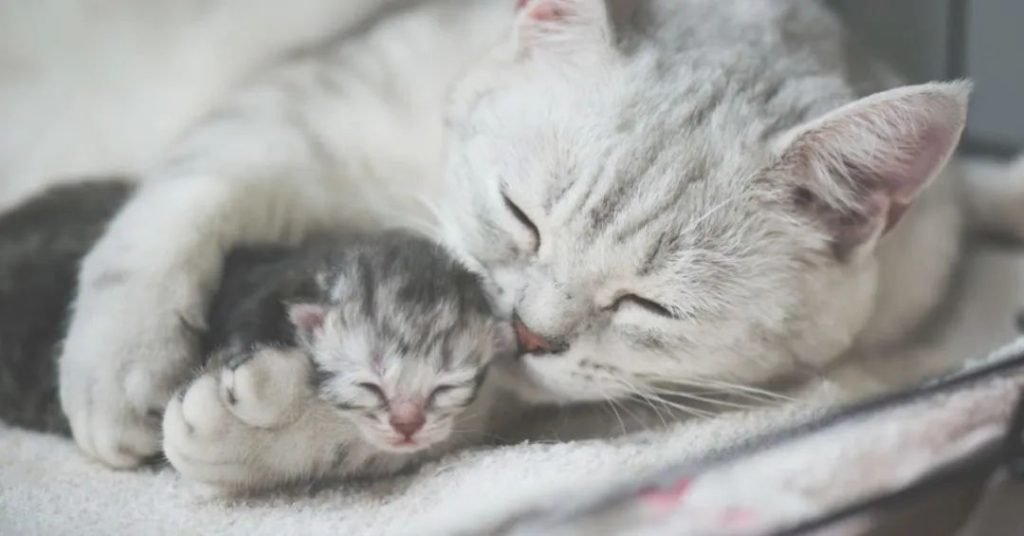
In cases where a cat is stray and not spayed in time, it is very easy for a mother cat to go into heat and become pregnant, turning from a single cat into a whole family… At this point, in order to provide a better life for the cats, kind-hearted people often step in to help find homes for the kittens. (And don’t forget to have the mother cat spayed!) After the kittens leave for their new homes, does the mother cat miss them? To answer this question, we first need to understand: Can a mother cat clearly recognize which kittens are hers?
-
Can a mother cat clearly recognize her own kittens?
To answer this question, we first need to understand if a mother cat can clearly identify her own kittens. Bánszegi and colleagues from the Mexican Institute of Biology were very interested in this, and they conducted experiments to explore it. They first allowed the mother cat to smell a group of kittens, and then gave her cotton swabs that had been rubbed on different kittens. The results showed that, compared to the other kittens, the mother cat spent less time sniffing her own kittens and the cotton swabs. Researchers believe this is because the mother cat is more familiar with the scent of her own kittens, suggesting that a mother cat can indeed recognize her own kittens in a crowd. For her to be able to identify her kittens so clearly, she must have paid a lot of attention and care to them. But does the mother’s love for her kittens remain the same over time?
-
Limited Maternal Love
To study whether a mother cat’s love changes over time, the team designed another experiment. Since mother cats are highly sensitive to the distress calls of their kittens, the researchers examined whether the sound of the kittens’ calls, from birth to weaning, affected the mother’s response over time. The team selected 8 mother cats and their kittens for this experiment. The test was conducted in a hallway with three connected rooms. The kittens and speakers (playing kitten distress calls) were randomly placed in one of the rooms, and the researchers recorded the time it took for the mother cat to return to the room. The results showed that as the kittens grew older, the mother cat became less responsive to their calls, even when the same kitten sounds were replayed. Over time, the mother cat gradually reduced the number of times she returned to care for the kittens and even showed less interest in nursing. Eventually, she even refused to let the kittens nurse. The researchers believe these changes in behavior are hormonally driven, allowing the mother cat to quickly move beyond the nursing phase, return to heat, and be ready for the next litter. So, while a mother cat does have love for her kittens, this love is time-limited. Once the kittens become independent, the mother cat steps back, and her maternal love likely fades away. Based on this, after the kittens reach 10-12 weeks old (8 weeks to wean + 2-4 weeks for skill development), separating them from the mother cat is unlikely to make the mother miss them. However, there are many benefits if the mother and kittens continue living together.
-
Benefits of Mother and Kittens Living Together
Benefit 1: Cats of the same bloodline living together have closer bonds. A 2003 study found that related cats groom each other more often and have stronger bonds. This was even more pronounced when the mother cat was present, and it was unaffected by whether the cats were spayed or not.Benefit 2: Kittens raised by their mother have better personalities. A study published in Nature in 2017 showed that many of a kitten’s behaviors are influenced by the mother during their early life. Kittens that grew up with their mother before 14 weeks old were quicker to adapt to new things, had lower aggression, and generally had better temperaments.Benefit 3: Kittens have stronger learning abilities. A 1969 experiment showed that the closer the relationship between a kitten and its mother, the stronger the kitten’s social learning ability. Another experiment by the Texas State University Psychology Department found that kittens raised by their mother were more open to and better able to adapt to new things as they grew older, with stronger learning abilities and faster learning speeds.Benefit 4: The mother cat helps reduce the kittens’ fear. A 1956 study found that when kittens were held by their mother, even the approach of strange cats or unfamiliar humans didn’t cause them much fear. They remained calmer in response.
Overall, as the kittens gradually grow older, taking them away from their mother likely doesn’t cause the mother cat to feel a strong sense of longing for them. So, there’s no need to feel guilty—rest assured and confidently entrust the kittens to a responsible “new mom”!