
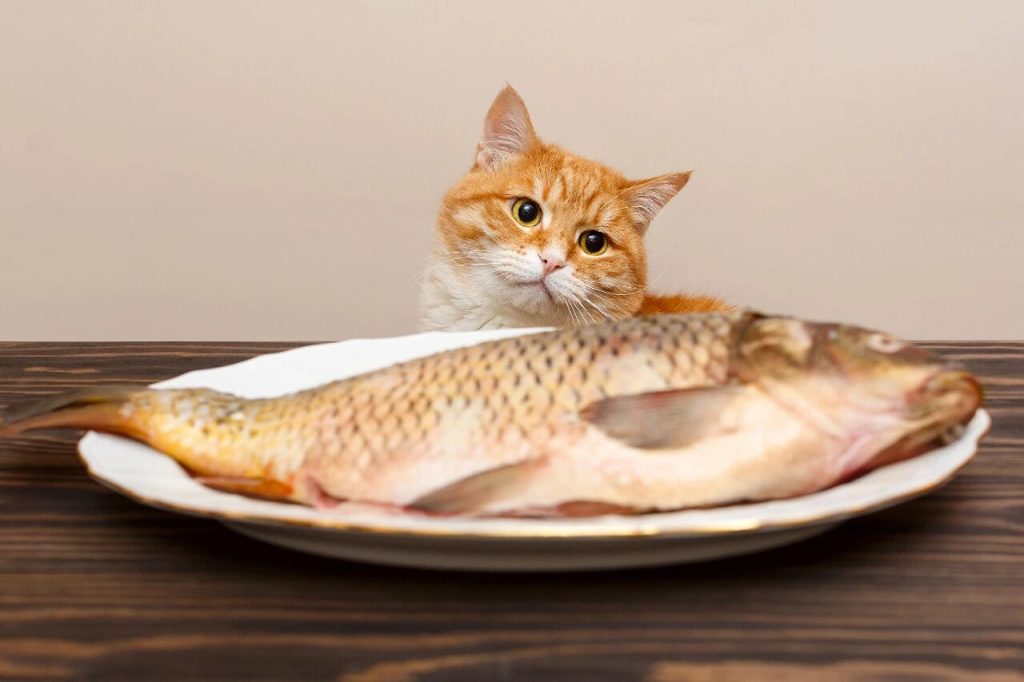
One evening, as you’re carefully using chopsticks to remove the bones from a plate of steamed fish, you notice your cat waking up from its nap nearby. It starts pacing around the dining table, occasionally rubbing against the corner. You decide to put a small piece of fish into its food bowl but suddenly wonder, “Could the fish bones get stuck in my cat’s throat?” To answer this question, we first need to clear up a common misconception. People often assume that fish is a cat’s favorite food. However, in reality, the majority of cats don’t actually eat fish, or only consume it in small amounts. As obligate carnivores, cats have a diet that spans a wide range of small animals that are the right size for them—over 2,000 species to be exact. Among these 2,000-plus food sources, fish is not included. One possible explanation is that the “cats” we are familiar with today originated around 10,000 years ago in the deserts of the Middle East. Their ancestors, known as the African wildcat, lived in an environment where large water sources were scarce, so they didn’t have access to fish as a food source.
-
Fish Are Still Not a Cat’s Main Food Choice, Even When They Need to Hunt
First of all, in the wild, both domestic and wild cats rarely catch fish. A study on the diet of island cats, which reviewed 72 research papers on the topic, found that out of 248 food sources for wild cats on islands, only two were fish. In urban areas, cats don’t typically target fish either. A study by the University of Sydney, which examined the hunting habits of cats across Australia, showed that urban cats kill an average of 186 animals each year, with reptiles, birds, and mammals making up the majority of their diet. Of course, cats are highly adaptable, and if they have easy access to fish, they will gladly indulge—historical evidence suggests that cats in the Middle Ages did consume large amounts of fish.
-
Cats Eat Fish Because They Have a High Protein Requirement as Obligate Carnivores
One reason cats may enjoy fish is that, as obligate carnivores, they have an extremely high protein requirement. Fish also provides essential nutrients like arginine and taurine, which are vital for their health. Additionally, certain fish, such as salmon, have a delicious taste that can trigger their appetite. So, it’s true that cats love dried fish and canned fish, but it’s rare for them to eat a whole fish on their own. In other words, it’s not common for them to encounter whole fish bones in their diet. But if they do come across raw fish bones, could they get stuck? In fact, because cats like to play with small objects and toys, they may easily swallow foreign objects, including fish bones, that get caught in their mouth or throat. The most common foreign objects found in a cat’s esophagus include needles, fish bones, other bones, small strings, and even fish hooks. For example, in a report on the treatment of esophageal diseases in 33 cats, two cats had bones lodged in their throats. In a separate case study of 30 cats with esophageal foreign body obstructions, 25 of the cats had swallowed needles. These objects share a common characteristic: they are hard, sharp, and long. The structure of a cat’s esophagus makes it particularly prone to having sharp, elongated objects stuck in it. The esophagus is a narrow, curved channel with sharp angles, which makes it easier for pointed objects to get caught.

-
The Four Narrowest Points of a Cat’s Esophagus
There are four key areas in a cat’s esophagus where it’s most likely for foreign objects to get stuck:The end of the pharynx (where the esophagus begins, where the upper esophageal sphincter connects)The base of the cardia (where the esophagus enters the stomach).The entrance to the chest cavity.The end of the esophagus.In the previously mentioned case study on esophageal blockages in 30 cats, the most common locations for obstructions were the end of the pharynx and the entrance to the chest cavity, which matches the narrow and curved structure of the esophagus. Another study of 65 cats and dogs with esophageal foreign bodies found that the end of the pharynx was still the most common site for blockages. While it’s rare for fish bones to get stuck in the throat, it’s not impossible. The role of the throat is to close off the windpipe during swallowing, preventing food from entering the trachea and causing choking. A case study of a cat with a throat foreign body clearly documented an instance where a fish bone—about 2 cm long and 1-3 mm wide—pierced the cat’s throat. Interestingly, this fish bone resembled the shape and size of a sewing needle. A typical sewing needle is about 3 cm long, with a diameter of around 2 mm. Since cats often get needles stuck in their throat, pharynx, or esophagus, it’s reasonable to assume that a similarly shaped fish bone could also cause perforation. The fact that you don’t often hear about cats getting fish bones stuck in their throats might simply be because most cats don’t typically eat whole fish.
-
Fish Bones Are Dangerous for Cats
Fish bones can be very dangerous for cats. If a bone gets stuck, mild symptoms include lethargy, loss of appetite, regurgitation, swelling of the throat, rapid breathing, and excessive salivation. In more severe cases, it can lead to respiratory failure, secondary pneumonia, and even life-threatening conditions.
This is why many cat care guides emphasize that cat owners should avoid letting their cats come into contact with fish that have bones, and also remind everyone to be mindful of their cats’ habit of playing with sharp objects. However, when a cat’s curiosity strikes, there’s no stopping it. For example, whether a cat likes fish or not is still a mystery, but one thing is certain: they absolutely love swallowing toy fish! It’s true—curiosity did get the better of the cat.