-
The Secret Behind Cats’ “Perpetual Motion Machine”
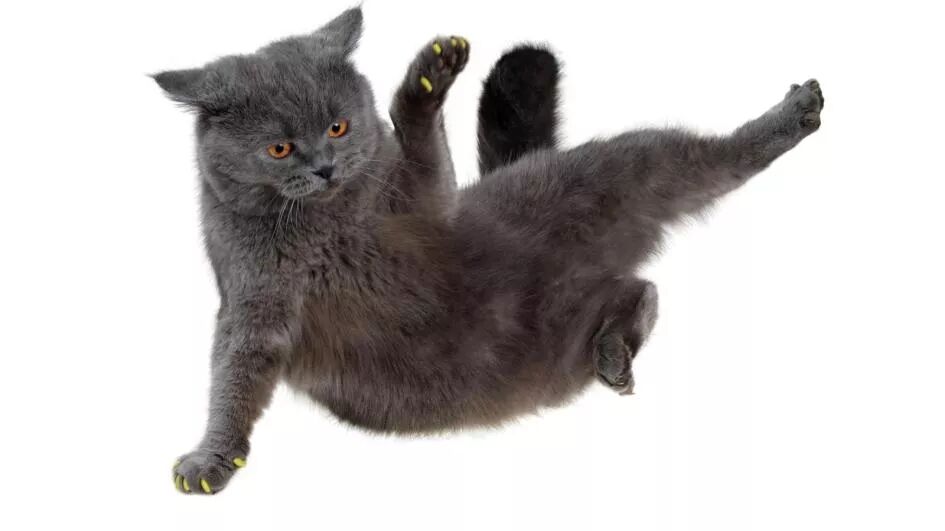
In daily life, there are always some things that seem impossible to explain with science.For example, when a buttered slice of bread falls, the buttered side always lands face-down on the floor.And when a cat falls from almost any height, no matter the position it starts in, it somehow manages to land steadily on all four feet.So people joke: if you tie a piece of buttered toast to a cat’s back, wouldn’t that create a perpetual-motion machine?Of course, the “cat perpetual-motion machine” is only a joke.But the cat’s ability to land on its feet from high places without external assistance is absolutely real.This skill is formally called the Cat Righting Reflex.
-
The Cat Righting Reflex
In the late 19th century, French scientist Étienne-Jules Marey wanted to “figure out the truth behind this cat magic” (basically, to study cats), so he invented chronophotography to record every moment of a cat’s fall.As expected, studying cats is the ultimate productivity booster (laugh).From the images, you can clearly see that cats use their extremely flexible spine to bend their body into two sections.They then extend their hind legs to rotate the front half, and the same movement happens in the lower body—completing the rotation mid-air.Once the falling height reaches 30 cm (about 12 inches), a cat can easily execute the Cat Righting Reflex.This life-saving skill is used in all aspects of a cat’s daily life and even gave rise to the legend that “cats have nine lives.”But… is the legend actually true?
-
High-Rise Syndrome
High-Rise Syndrome refers to all injuries that occur when a cat falls from a height equal to or higher than about two stories (each story roughly 3–4 meters).In other words—a cat high-rise fall.Why do cats fall?Cats really are silly little creatures—they absolutely can play themselves into trouble.Hunting instinct: Flying bugs, birds—“all mine!” One wrong step while chasing and… down they go.Love of freedom (small living space): “I know every corner of this home. I must go find the One Piece.”Good at climbing up, terrible at getting down: Their claws are built for climbing up, not down. Result?“Help! I’m stuck in a tree! Someone rescue me!”Light interference: Laser pointer or reflections look too tempting… one distraction and they slip.Not neutered: “The world outside smells like hormones. No window can stop me from finding love.”.A 1987 study found that over 90% of cats with High-Rise Syndrome survived after receiving timely veterinary care.A 2013 study by Merbl et al. updated the data: after excluding cats that were euthanized by owner choice, the survival rate was 83%.But these statistics mostly come from university hospitals with excellent equipment and care.In small clinics, survival rates are often lower—and many cats do die from falls.Remember: these numbers are based on cats that received treatment.If rescue is delayed, the outcome can be fatal.Cats definitely do not have nine real lives.
-
What Actually Happens When a Cat Falls?
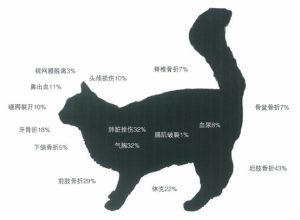
Here’s a more intuitive summary:Even though cats rely on their righting reflex and tail to adjust their posture mid-air—as if they have cheat codes—they still cannot guarantee their safety.Common injuries from High-Rise Syndrome include:Fractures.Most commonly in the limbs.Also includes skull injuries, spinal fractures, and pelvic fractures. External trauma.Soft-tissue contusions, puncture wounds from clotheslines, branches, or other objects encountered during the fall.
Bone exposure and bleeding may also occur.Internal injuries.Internal organ bleeding.Pulmonary contusion.Pneumothorax (air leakage in the chest cavity).Nosebleeds.Bladder bleeding or rupture.Pancreatitis.For unknown reasons, cats falling from heights above 6 meters (about 20 ft) frequently develop pancreatitis within three days.Possible reasons include temporary lack of blood supply or shock trauma.
-
As an Owner, What Can You Do?
If a cat falls from the 2nd floor or lower.And behaves normally (eating, drinking, moving fine), observe closely for three days.Watch for:Appetite.Energy levels.Breathing abnormalities.Broken or cracked teeth.If possible, still take the cat for a vet check.If a cat falls from higher than the 2nd floor.Go to the vet immediately!While preparing to go to the hospital, check the following to help the vet respond quickly:Be careful — pain may cause the cat to attack. Approach slowly.Check for:Bleeding:Look for wounds or blood.Apply pressure with a clean cloth or towel if bleeding is present.Mucous membrane color:Pale gums indicate poor perfusion, excessive blood loss, or shock.Gait:Limping or inability to walk suggests fractures or soft-tissue trauma.If unable to walk—do not move the cat unnecessarily.Breathing rate:Pain or blood loss can cause rapid, shallow breathing.Mental state:Unconsciousness, dullness, or crying from pain are all warning signs.After contacting your vet, transport the cat carefully.Use a carrier, box, or sturdy board, and pad empty spaces with towels to prevent sliding and secondary injuries.
-
What Will the Vet Do?
Different injury severities require different treatments, but common procedures include:Ultrasound (B-scan).Checks for:Internal bleeding.Organ damage.Bladder rupture.Chest/abdominal fluid.X-ray.Evaluates:Bone fractures.Pneumothorax.Chest/abdominal abnormalities.Abdominal tap.Used when bladder rupture is suspected.Oxygen therapy.Improves low oxygen caused by trauma or blood loss.Pain management.Reduces pain to stabilize the cat before treatment.Temperature stabilization.If the cat is hypothermic from blood loss, vets may use warming pads or warmed IV fluids.Fluid therapy / Blood transfusion.Used for shock or major blood loss.(Cats must be blood-typed before transfusion.)Surgery.Performed after stabilizing the cat if fractures, puncture wounds, or organ injuries require it.
To prevent these kinds of stressful incidents, follow the steps below:Window Safety—The Absolute Priority.The most important measure is securing your windows.Overseas cat owners often install outdoor protective screens to satisfy their cats’ curiosity about the outside world. However, for owners living in high-rise apartments in China, this isn’t usually feasible.Especially in summer, always close the window screens when windows are open. If your home doesn’t have screens, contact a professional installer immediately. Prefer metal or hard screens for maximum safety—soft screens are not reliable.Eliminate Potential Hazards.Keep your cat’s activity areas away from balconies or window edges.Some owners may place toys or food near these dangerous zones—move them elsewhere.Also, during playtime, make sure your cat stays far from windows or balconies.Provide Enrichment and Vertical Space.If possible, increase your cat’s activity space and vertical areas indoors. This expands their territory and helps reduce their fixation on the outdoors.Spaying or Neutering Helps.Neutering can further reduce the lure of the outside world, but window safety always comes first.