
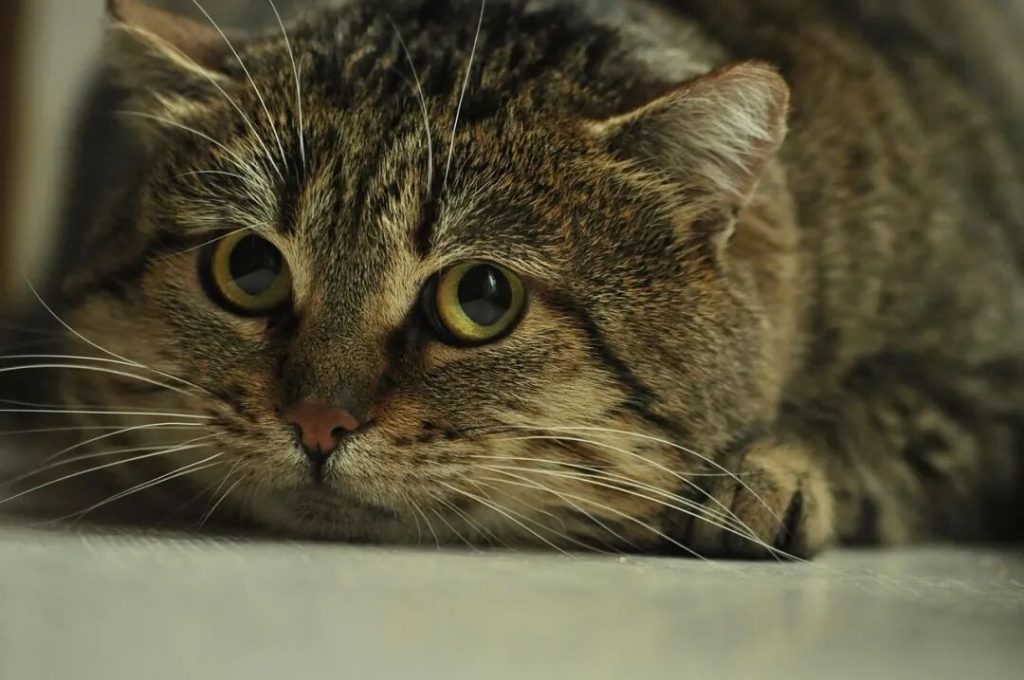
A few times when I walked home after work, I deliberately stopped at the building’s entrance, took out my phone, and checked the live feed of the security camera inside my house. Then, I would shout toward the bedroom window on the fifth floor, “Bebe!” Every time, Bebe would respond. The once-quiet cat would immediately start meowing. Sometimes, she would stay in place but look around, meowing, or she would run to the door and meow nonstop, until I went upstairs, washed my hands, and started petting her, after which she would settle down.A 2019 study confirmed what I, along with many other cat owners, have suspected—cats can recognize their own names. When a cat hears its owner calling its name and pretends to ignore them, it’s not because the cat doesn’t hear; it’s just that they don’t feel like responding. But the cat’s ability to recognize names doesn’t stop there. Recent research this year has shown that in multi-cat households, cats can also recognize the names of their fellow companions.
-
Cats at Home vs. Cats in Cat Cafes
Saito Chiko, a seasoned cat owner with a 15-year-old black cat named “Police Cat,” is also a psychology professor at Sophia University in Japan. She specializes in the cognitive behaviors of cats and the relationship between cats and humans, areas in which she has participated in numerous studies. This particular study was split into two experiments.The first experiment involved 48 cats, 29 of which were from different cat cafes and 19 from multi-cat households (with at least three cats per household for the study). The participating cats first listened to a recording in which the owner called out “Cat A” four times—Cat A being a cat living with the experimental cat or working at the same cat cafe. After the recording, the cats were shown a photo, which was either of “Cat A” or “Cat B”—another cat living in the same household but not named in the recording.The results showed that when the face of the cat on the screen didn’t match the name they heard, the cats from the cafes did not seem confused, but the cats from the households stared at the screen for a longer time. Researchers believed this to be a case of the “violation of expectation effect.” In other words, when the cats heard their companion’s name and then saw a different face, they might have felt confused or expected something different.The second experiment followed the same procedure, but instead of calling out the cats’ names, the recording used the names of human family members, followed by their photos. Because the voice on the recording was not from their familiar owner, the household cats did not show a noticeable violation of expectation. However, the study found that the more human family members there were, and the longer the cats had lived with humans, the more confused they became when the name did not match the face.These findings suggest that cats are observing your every move, whether you realize it or not.

-
Being Influenced by Familiar Sounds + Secretly Observing
The cats participating in the experiment had not received special training, so the process wasn’t entirely smooth. During the facial recognition phase, some cats completely ignored the screen, and one cat even ran off after hearing the recording, hiding in a high spot to avoid the experiment. Data from these cats were excluded. Researchers believe that the ability to recognize the names of companions involves social learning—simply put, through everyday observation and interaction, cats learn certain behaviors.Unlike cafe cats, house cats are more likely to hear their owner call other cats’ names and frequently observe the reactions of other cats when they hear their names. In multi-cat households, feeding times also provide a stronger motivation for cats to remember the names of other cats. For example, when a cat hears its name called, it might expect food, but when it hears another cat’s name, it knows it can only watch the “live eating broadcast.”In Experiment 2, the cats did not show a clear ability to recognize the names of other human family members, possibly because there is no competition between humans and cats. But when more humans live with the cat and they have more opportunities for social learning, the cats become more adept at recognizing names. However, this study also had limitations—such as not considering the time cats had spent living together or controlling for age and emotional factors. These factors are difficult to manage, and in some multi-cat households, cats can’t even coexist peacefully and must be separated, making their cohabitation time hard to measure. While the researchers provided possible explanations and motivations, the exact mechanism by which house cats learn to recognize the names and faces of other cats remains an unsolved mystery, requiring further research.
-
Will Cats Become More Like Dogs?
Currently, most studies on companion animal cognitive behavior focus on dogs. In comparison, research on cats is much less common. Dogs, being “man’s best friend” for centuries, have learned to respond to their names and various nicknames, and they’re also used to hearing the voices of strangers. “When you bring a cat into the lab, they freeze up,” says cognitive psychologist Jennifer Fong. Saito Chiko believes that the social evolution of cats is still ongoing. In 2019, she and her team discovered that cats respond to their names, whether the voice is from their owner or a stranger—though, of course, the response is stronger when they hear their owner calling.This is likely because cats have associated their name with rewards, such as food and petting. A study published in October this year also showed that cats can distinguish between the voices of their owners and strangers. Moreover, when owners use two different tones—one when talking to a person and another when speaking to the cat—the cat will respond more strongly to the latter.In recent years, as more people have adopted cats (especially during the pandemic), cats and humans have spent more time together, and their relationship has become increasingly close. As a result, cats may become better at understanding human voices and other cues. Of course, whether they choose to respond is a different matter. Aloof cats may often ignore us, but they can also be quite affectionate, just like babies or puppies. In other words, we’re not just caregivers to cats, but also their companions—those they long for, trust, and rely on.
In recent years, cats have become increasingly popular as pets, not because people need them for pest control, but because they serve as companion animals offering emotional support. And now, perhaps more and more people are in need of this kind of companionship.