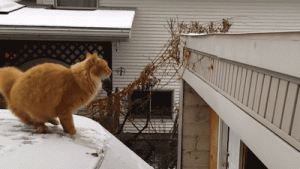
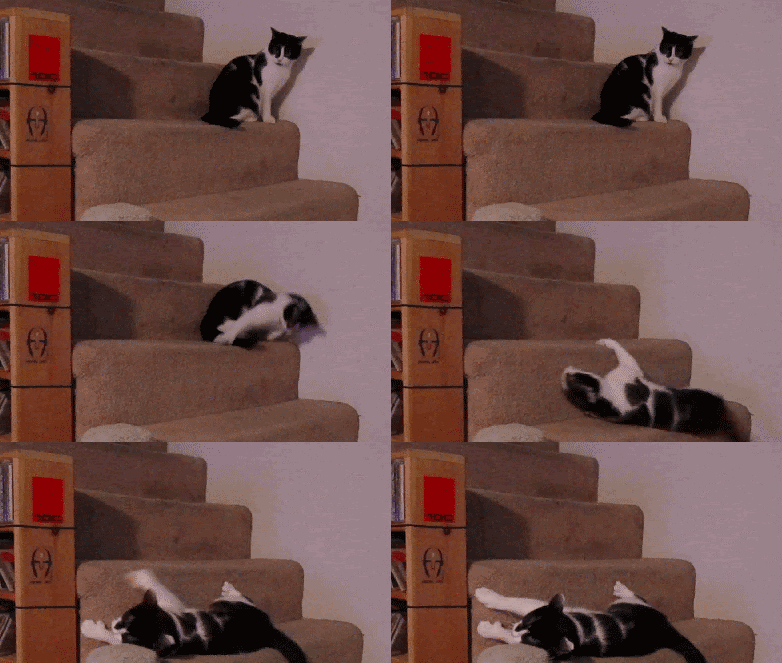
A netizen named YellowRiot shared that her cat fell from the 24th floor to the 3rd floor and survived without any injuries. She mentioned that after researching, she discovered that the higher the floor, the less likely it is for a cat to die from a fall. However, another user, quisa19, expressed regret over the tragic loss of her cat, which fell from the 26th floor and died on impact. Quisa19 admitted that her negligence contributed to the accident. Mewo Demi, who once worked part-time in an emergency veterinary clinic at a university animal hospital, stated that she regularly receives cats with fall injuries—about every two nights—and the survival rate after treatment is approximately 70%.
-
Obviously, cats are not invincible when it comes to falls. Kids, please don’t try to experiment with cats from high buildings.
However, what is the real survival rate of cats after falling? Is it really over 90%? Cats are often considered mysterious creatures. A Chinese saying goes, “A cat has nine lives.” The closest source to the “cats can’t die from falling” idea comes from a paper titled “High-Rise Syndrome in Cats”, published in the Journal of the American Veterinary Medical Association in 1987. This paper marked the beginning of the field of feline fall dynamics. Through a five-month study tracking cats that had fallen from buildings and been treated at a pet emergency hospital in New York, the article first highlighted an unexpected phenomenon: cats injured from falls from lower floors (below the sixth) tend to have more severe injuries than those falling from higher floors. This was the first documented exploration of the subject, and it sparked an interest in feline fall incidents, leading to further studies. Studies worldwide have compiled data from veterinary hospitals on the injuries and outcomes of falling cats, and some general conclusions have emerged: kittens are more likely to fall, cats are more likely to fall in warm weather, cats from the third and fourth floors are more likely to fall, and the survival rate of cats that fall is as high as 90%. The saying “The higher you climb, the harder you fall” would suggest the opposite, yet cats’ seemingly contradictory behavior has piqued people’s curiosity. The most widely circulated explanation is that after a certain height, a cat reaches a terminal velocity, allowing it enough time to adjust its body posture, relax its muscles, and distribute the impact, thus preventing fatal injuries. This interdisciplinary hypothesis, combining physics, biology, and psychology, has gained traction and been passed along as a fact, with more details added over time. Some believe that cats are arboreal creatures, often falling from trees, which may have contributed to their “fall-resistant” genetics. Others suggest that cats can glide like flying squirrels, even though they don’t have wing-like membranes. Another theory posits that when falling from a high enough height, cats no longer perceive themselves as in freefall, and their relaxed state helps slow their descent. Regardless of the explanation, the idea that cats are invincible when they fall has become widely known as a quirky fact. People write popular science articles, create GIFs, and design interactive presentations to demonstrate cats’ survival strategies after a fall, marveling at their resilience, but often overlooking the undeniable fact: many cats do not survive falls from high floors.
-
Dead cats don’t talk, and they don’t make it into the statistics at pet hospitals.
For the past thirty years, the data on feline fall dynamics has been collected from veterinary hospitals around the world, and there is no “scientific” experiment involving a sadistic cat abuser throwing hundreds of cats from different floors. Therefore, these statistics inevitably carry systemic biases—only cats that are considered worth saving by their owners make it to veterinary hospitals. Can you imagine the scene of a pet owner carrying a limp, injured cat to a vet for treatment? By contrast, cats that fall from lower floors often aren’t taken to the hospital unless they show obvious signs of injury. This explains why the injury rate is higher for cats falling from lower floors than from higher ones. Cats that fall from low floors are either unharmed or injured, but the ones that are fine are not included in the statistics. As a result, the injury rate for low-floor falls is skewed higher. On the other hand, cats falling from higher floors may die on impact, while the surviving ones are either injured or, by sheer luck, unharmed. Owners of these surviving cats are more likely to take them to the hospital, which lowers the apparent injury rate. The 90% survival rate cited in the papers refers not to the overall survival rate of cats falling, but the survival rate of cats that were treated at pet hospitals. This high survival rate doesn’t suggest that cats are particularly good at surviving falls, but rather that owners who take their cats to the hospital after a fall tend to have a high success rate in saving them. Cats that died before reaching the hospital, or those whose injuries were too severe to treat, or those that died on impact, do not factor into the 90% survival rate. Similarly, conclusions like “kittens are more likely to fall, cats are more likely to fall in warm weather, and cats falling from the third and fourth floors are more likely to survive” should be modified to reflect that these trends are only evident among the cats that are treated at veterinary hospitals after a fall. These findings don’t mean that kittens, cats from the third or fourth floors, or cats in warm weather are more likely to jump or fall. Instead, it suggests that in warm weather, pet owners are more likely to leave windows or doors open, increasing the chance of cats falling. Studies have also supported this theory—when temperatures rise to the point that people turn on their air conditioners, the frequency of cats falling from windows decreases.
The conclusion is simple and blunt—cats can die from falls! Experienced pet owners know that the most important thing is to take preventive measures and eliminate any opportunities for cats (or other pets) to fall. If a fall does happen, according to research from cat owners around the world, the survival rate is around 90% if the cat is brought alive to a veterinary hospital (another influencing factor is the level of care provided by the hospital).