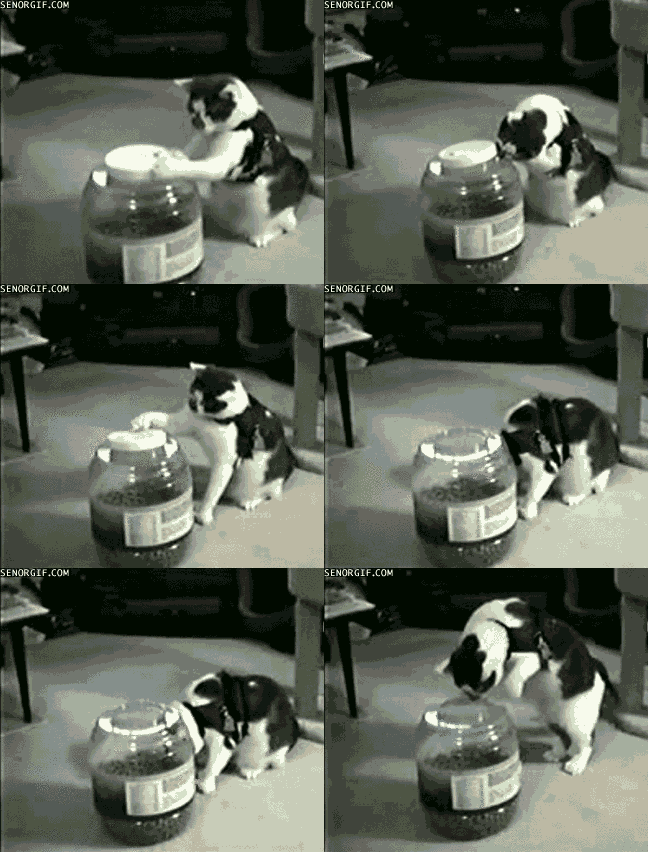
Some Cats Pick Up Strange “Skills” from Living with Their Owners.Some cats, over time, develop odd “skills” while living with their owners. For example, they might learn to turn the doorknob to open a door, open drawers to search for food, and eventually, even unlock things! These behaviors are often learned through observing their human companions. So, does this mean cats are capable of watching and imitating human behavior?
-
Let’s Take a Look at an Experiment
In 2019, a research team from Roland University in Hungary conducted an imitation experiment with a cat named “Ebisu” from Aichi Prefecture, Japan. Why was Ebisu chosen? Because this cat is both a foodie and a “top student” in the cat world! Ebisu, known for having a strong appetite, was selected for the experiment because its owner used this motivation to teach Ebisu human-like actions. Before this experiment, Ebisu had already undergone similar imitation training, including tasks like spinning in place, touching a wobbly toy with its paw, picking up a rubber band from a clothes hanger, opening drawers, lying down, and standing on its hind legs. Ebisu’s owner, Fumi Higaki, is a well-known dog trainer famous for the “DAID” training method (and this method would be used to test Ebisu in the current experiment).Preliminary Tests: What? Cats Have Mock Exams Too?Before the official experiment started, Ebisu had 21 days of review time, which included two extra “mock exam” tasks: opening a sliding plastic container lid and placing its forearm on a book. In the mock exam, our “top student” Ebisu learned to open the container lid on the first try. However, when it came to placing its forearm on the book, Ebisu initially only offered one paw, sitting firmly without moving. It wasn’t until the book was placed farther away that Ebisu moved forward slightly to place its forearm on the book, completing the task.The Official Experiment: What Will It Test?As mentioned earlier, the official experiment used the “DAID” method on Ebisu. What exactly is “DAID”? It’s short for “Do As I Do.” This behavior model is familiar from childhood shows like The Smart Tree, and it basically means, “Do it like I do, and I’ll do it like you.” The method involves the owner first performing an action (e.g., extending a hand to touch an object) while giving the cat the command “Do it.” After 20 seconds, the cat is expected to replicate the action. The owner then performs another action and waits for the cat to repeat it. In this official experiment, Ebisu was to learn two completely new actions. Would it succeed?
-
The Experiment Begins: Will Ebisu Succeed?
The experiment officially started on a December evening in 2019. It’s important to note that by March 2019, Ebisu had experienced a significant decrease in activity and appetite due to illness. The once food-obsessed “top student” cat—could it still perform as before? The experiment took place in a pet shop that Ebisu was very familiar with. Ebisu sat on a 72cm high table, facing its owner, Fumi Higaki. A cardboard box, roughly the size of a smartphone box, was placed 50cm away from Ebisu. The two new actions Ebisu had to learn were: to touch the box with its paw and to rub its face against the side of the box. The researchers required Ebisu to repeat the task 18 times.Results of the Experiment:The results showed that Ebisu successfully imitated actions 81.2% of the time. After eliminating two ineffective actions, Ebisu successfully imitated 13 out of 16 valid attempts. Statistically, the results were significant—Ebisu succeeded in mimicking the actions. However, there were three instances where Ebisu made an object error. In these cases, Ebisu was supposed to rub its face against the box but instead rubbed the tabletop. Statistically, the results showed no significant evidence that Ebisu understood that imitation involved specific objects.
-
So… Do Cats Really Imitate Humans?
From Ebisu’s experiment, we can see that cats may indeed be capable of imitating human behavior. While this might seem like a simple task, for cats, it’s more complex. First, the cat has to understand that the owner wants them to “imitate” and not simply “express.” Secondly, the cat needs to translate human actions into their own body movements, despite the significant difference in anatomy. For example, when humans speak, cats don’t understand words, but when the owner raises a hand and points, the cat must understand that the goal is not for the cat to follow the direction or smell the object but to imitate the movement. Additionally, the cat must associate the human hand with its own front paw in order to replicate the action.
So, Ebisu is definitely an impressive cat! However, it’s still too early to definitively say that cats can imitate human actions. After all, Ebisu had already undergone some training, and we can’t be sure if the same results could be replicated with other cats. In conclusion, to truly confirm this, more scientific research is needed. That said, based on Ebisu’s experience, it’s clear that cat owners can train their cats to learn certain skills! What skills can your cat do?