These days, “cat cuddling” has become a popular and much-loved activity for many people. You might see a group of office workers gathered around their colleague, petting a cat during a break; or on the streets, you might spot a few quirky uncles or aunts chasing stray cats, eager to pet them; and at home, you’re the one cleaning the litter box while being ignored by your cat. Whether it’s a two-dimensional (cartoon) cat or a three-dimensional (real-life) cat, whether it’s a solidified cat or a flowing liquid cat, you’re likely to be completely captivated by them.Marc-Antoine Fardin, a researcher from the University of Lyon in France, is a scientific enthusiast of “cat cuddling.” Through rheology’s “Deborah number,” he demonstrated that “cats can be both solid and liquid” and even won the 2017 Ig Nobel Prize in Physics for his discovery.To prove that cats “can be both solid and liquid,” we first need to understand a few key concepts:Solid: A state of matter where the substance maintains both its shape and volume.Liquid: A state of matter where the substance maintains its volume but adapts to the shape of its container.Gas: A state of matter where the substance expands to occupy the entire volume available.Deborah number (De): A dimensionless number in rheology used to describe the flow behavior of materials under certain conditions. It’s defined as the ratio of relaxation time to observation time scale. When De<<1, the material behaves like a fluid; when De>>1, it behaves like a solid.Feeling a bit confused? No worries, let’s simplify this with an example.
-
How to Get a Solid Cat?
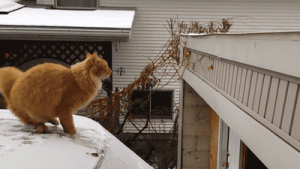
On a short time scale, a standing or jumping cat would be considered a solid cat. This is because the cat’s relaxation time (ranging from 1 second to 1 minute) is much greater than the short observation time (1 second). In other words, in one second, you might see your cat bouncing around, and in the next, it has already turned into a “puddle”—you won’t be able to catch the process of it “flowing” into liquid form.
-
So, How to Get an Adorable Liquid Cat?
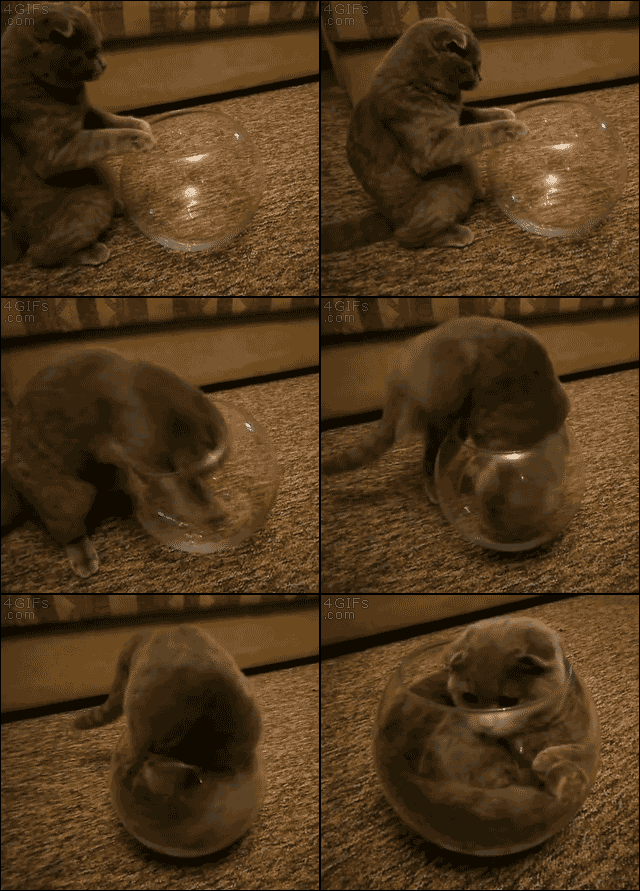
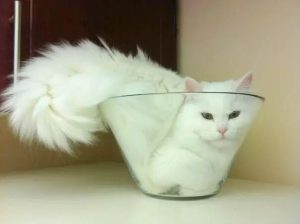
On a longer time scale, when you find a cat occupying the shape of a wine glass or other container, you can consider this cat to be in a liquid state. However, the flow behavior of a cat also depends on its age. Younger cats and older cats have different levels of flowability. Older cats have a longer relaxation time, which can last for several hours. From a purely liquid versus gas perspective, older cats tend to lean more towards being gaseous.Of course, besides the cat’s activity level and age, a cat’s flowability also depends on the surfaces it interacts with. For example, effects like the lotus leaf effect, the roughness of the fur, the low affinity for smooth surfaces, and the viscosity shown on vertical surfaces all play a role. Additionally, due to the inherent movement of cats, they don’t behave like other fluids (such as water), which are passive. Instead, cats show a certain instability in their rheology: while they may be liquid in your arms, the moment they walk away in disdain, they instantly return to a solid state.
In conclusion, cats have proven to be a rich model system for rheological studies in both linear and nonlinear regimes. Just as Heraclitus’ philosophy “Everything flows, nothing remains” is considered the motto of rheology, we can say that “All cats flow, no cat remains” is the motto of cats.